Thursday, June 9, 2016

Nathan Lewis, Making Art Out of War Debris

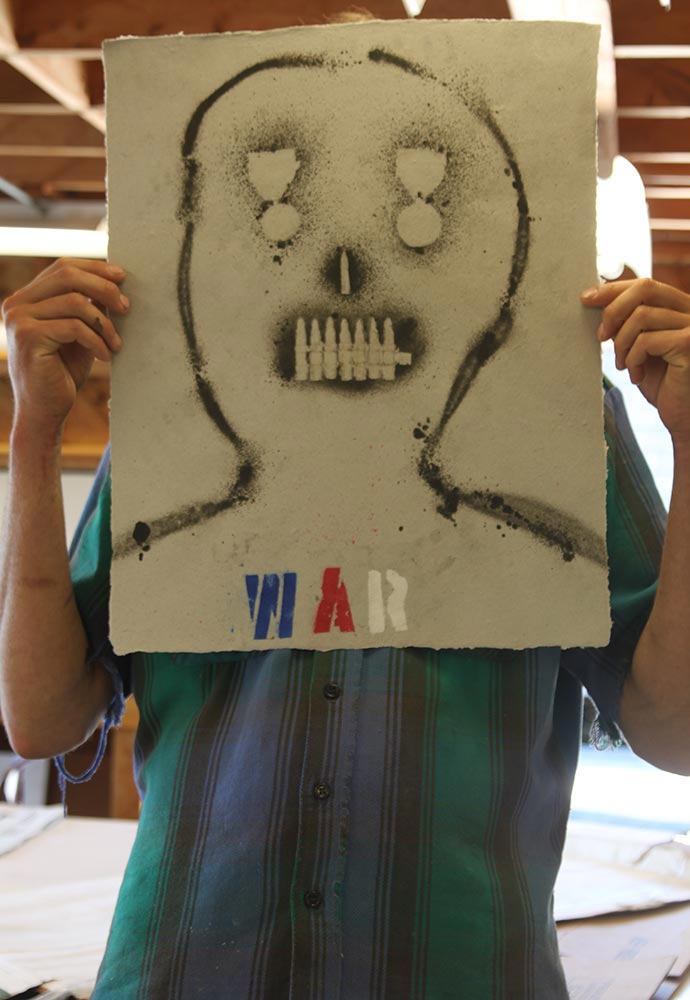
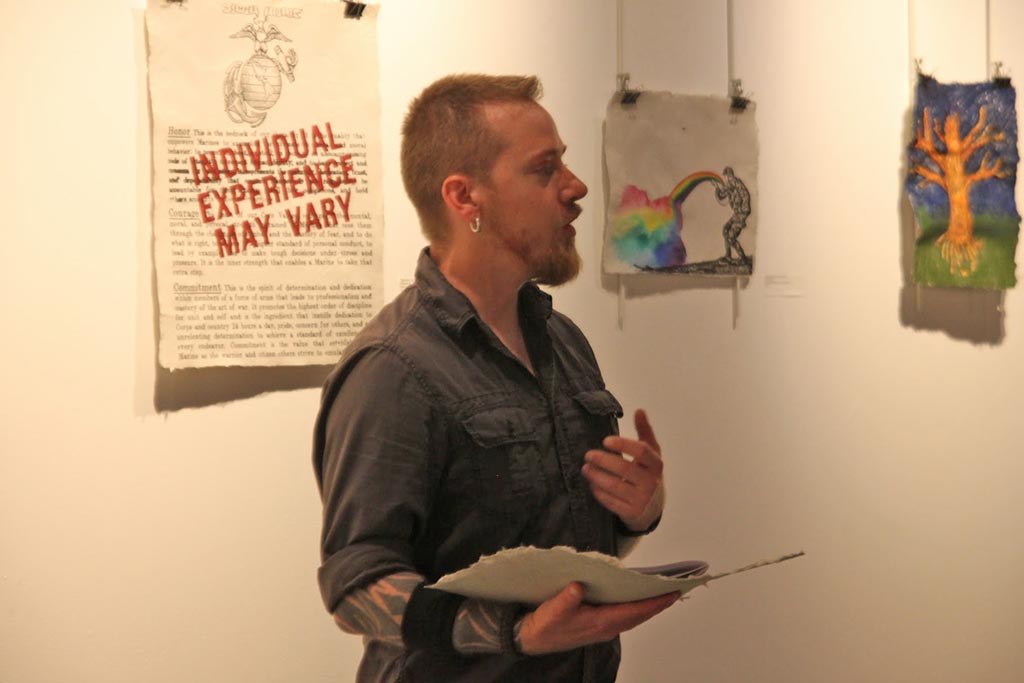
Nathan Lewis at work


Nathan Lewis, who served in Iraq in an Army artillery unit, “is a master papermaker and writer, living in the farmland outside Trumansburg [NY]. He is one of the thousands of veterans who report symptoms of PTSD, but Lewis prefers the term ‘war trauma,’ because it’s more accurate,” noted a profile in The Ithaca Voice.

A Combat Paper and Warrior Writers instructor who helps run workshops and retreats from Maine to Virginia, Nate Lewis’ work as an organizer of art, writing and organic farming projects to assist veterans in coping with war trauma has been profiled in The New York Times, as well as in local publications in upstate New York. He is also an author of two collections of his poetry, prose and art that were handmade and published under the imprint of Combat Paper Press. His signature art work incorporates spray painted impressions of bullets, dog tags and other war artifacts.

Selections of Nate Lewis’ work will appear in “Combat Paper & Beyond,” an art exhibition running June 18 through July 9 at the Puffin Cultural Forum, 20 Puffin Way, Teaneck, NJ. The art show grand opening is Saturday, June 18 at 4 pm.

The exhibit explores the vision of the Combat Paper Project through innovative artwork created by veterans and non-veterans. Multi-media work by Eli Wright is featured with additional works by award-winning artists Jim Fallon, David Keefe, Rachel Heberling, Elisabeth Smolarz, Frank Wagner, Ron Erikson and others.


How to Make a Combat Paper Book
Inspired by Chris Arendt’s How to Make Combat Paper

By Nathan Lewis

1. Play Army in the woods
2. Put up F-14 Tomcat Jet-Fighter wallpaper above your bunk bed
3. Agree to a pizza date with the local Army recruiter
4. Graduate high school, watch the planes hit the towers, graduate basic training
5. Mix 1 part nationalism with 1 part college money, stir in ½ baked optimism
6. Train, get desert gear, deploy to Iraq
7. Arrive in Kuwait, breath fumes from oil wells
8. Drive to Baghdad, load munitions onto truck, repeat for 3 months
9. Get flat tires, stares from Iraqis and meet friendly kids
10, Forget to strap down box of hand grenades, take a turn too fast, spill onto busy street, keep driving
11. Take pictures, don’t change clothes, eat meals out of metal pouches
12. Watch traffic accidents, watch the truck in front of you burn,
watch commanders get blown off burning truck by mortar rounds
13. Return home, get drunk, grind kitty litter into oil stains in motorpool, repeat for 3 months
14. Get out of the Army, enroll in college, get a job
15. Think about steps 1-13 often
16. Start writing, in groups, alone, in public, in the basement, repeat for 6 years
17. Read WWI poets, read Vietnam War poets, read Iraq War poets,
become inspired by peers of the past and present
18. Collaborate, Collaborate, Collaborate
19. Start your first book with a poem about shitting in the sand
20. Send book to Harvard and your Grandparents
21. Ask for help, receive it, be grateful, live simple, speak your mind, plant seeds
22. Help others with steps 14-21, feel good again


photos: warriorwriters.org


Tuesday, June 7, 2016

Odyssey of Combat Papermaker Jim Fallon

Jim Fallon

He didn’t set out to be an artist, yet Combat Papermaker Jim Fallon took 1st Place in the 2015 National Veterans Creative Arts Festival, sponsored by the US Department of Veterans Affairs and the American Legion Auxiliary. Entitled "Orphans' Opus '68," the winning work is an image from a photo Fallon took of Vietnamese orphans behind a gate merged with the strings of a grand piano. The silkscreen print is on paper made from Vietnam war uniforms.

Selections of Jim Fallon’s work will appear in “Combat Paper & Beyond,” an art exhibition running June 18 through July 9 at the Puffin Cultural Forum, 20 Puffin Way, Teaneck, NJ. The art show grand opening is Saturday, June 18 at 4 pm.

The exhibit explores the vision of the Combat Paper Project through innovative artwork created by veterans and non-veterans. Multi-media work by Eli Wright is featured with additional works by award-winning artists Jim Fallon, David Keefe, Rachel Heberling, Elisabeth Smolarz, Frank Wagner, Ron Erikson, Nate Lewis and others.

Born in Hoboken, NJ and raised in Jersey City, Fallon is retired and living in Hoboken. He served in Vietnam as a medic in an Army Reserve Medical Field Hospital Unit. During his tour in Vietnam, he also assisted a local orphanage, providing food, toys and extra medical supplies for the children.

He returned home to bartending, playing music in jazz clubs and working as a union representative. For a period of time he owned the Half Note Jazz Club in the Village in NYC. He also lived in Los Angeles, CA for 18 years working as a bartender and union representative. He’s an active member of many veterans’ organizations including Vietnam Veterans Against the War, Veterans for Peace, Secaucus Veterans Center, Combat Paper NJ, Agent Orange Organizations and as a Service Officer for the DAV. Despite a severe arm injury from cancer due to exposure to Agent Orange chemicals, he took up art in a workshop several years ago at the Secaucus Vets Center.

Jim Fallon’s Combat Paper art has appeared in numerous exhibitions, including at the Vietnam Veterans Memorial in Holmdel, NJ, Gloucester County College, Brennan Gallery at the Brennan Court House in Jersey City, Jersey City Art & Studio Tour, and on display as the first place entry in the October 2015 National Veterans Creative Arts Festival in Durham, NC.

"Orphans' Opus '68" by Jim Fallon


Friday, June 3, 2016

“Combat Paper & Beyond” Art Show at Puffin Cultural Forum


Eli Wright at Combat Paper art show (photo: warriorwriters.org)


Art crafted from recycled military uniforms, bullet impressions, barbed wire, midnight memories and other artifacts of war is the centerpiece of “Combat Paper & Beyond,” an art exhibition running June 18 through July 9 at the Puffin Cultural Forum, 20 Puffin Way, Teaneck, NJ.

The art show grand opening is Saturday, June 18 at 4 pm. The event includes remarks by artists, a Warrior Writers poetry jam and music by singer/songwriter Tamra Hayden.

The exhibit explores the vision of the Combat Paper Project through innovative artwork created by veterans and non-veterans. Multi-media work by Eli Wright is featured with additional works by award-winning artists Jim Fallon, David Keefe, Rachel Heberling, Elisabeth Smolarz, Frank Wagner, Ron Erikson, Nate Lewis and others.

The exhibition is curated by Walt Nygard and Jan Barry, both of Teaneck, who served in Vietnam in the US Marine Corps and Army, respectively. They have curated previous art shows and poetry presentations by veterans at Puffin, the Brennan Galley in the Brennan Courthouse in Jersey City and other locales.

A combat medic in the US Army in Iraq, Eli Wright currently serves as co-coordinator of the Combat Paper Project at the Printmaking Center of NJ in Branchburg. He heads a team of Combat Paper and Warrior Writers instructors who provide art workshops for veterans and active duty soldiers at a number of locations in New Jersey and other East Coast states, including Walter Reed National Military Medical Center in Maryland and Fort Belvoir, Virginia.

Other artists include David Keefe, co-coordinator of Combat Paper NJ, a Marine veteran of Iraq who teaches a Combat Paper art course at Montclair State University, whose work has been displayed at Princeton University’s Bernstein Gallery, among many other galleries; Frank Wagner, of Bogota, a Vietnam veteran, whose works have won regional VA art awards; and Jim Fallon, of Hoboken, who served with the Army in Vietnam. One of Fallon’s Combat Paper art works won a national VA art award.

Paintings by Ron Erickson, a Bogota-based artist, were recently on display at an exhibit titled “Suburban Eyes” at the Edward Williams Gallery at Fairleigh Dickinson University.

Rachel Heberling is the studio program manager at the Printmaking Center of NJ. Her work has been exhibited internationally, including at the National Arts Club in New York City and the Corcoran Gallery in Washington, DC.

Nate Lewis, who served in the Army in Iraq, runs a Combat Papermaking studio on a farm near Ithaca, NY.

Among the writers participating in the Warrior Writers poetry jam: Jennifer Pacanowski, an Army veteran of Iraq, works with theater groups in New York City on dramas about the transition from war to civilian life and runs writing workshops for veterans in many locations; Everett Cox, a Vietnam veteran, coordinates Warrior Writers workshops in Orange County, NY; Kevin Basl, who served in the Army in Iraq, coordinates Warrior Writers workshops and book projects in a number of locations on the East Coast; Sarah Mess, an Army veteran of the war in Somalia whose poetry won a regional VA art award.

Warrior Writers offers writing workshops for military veterans and family members, including monthly gatherings at the Geraldine R. Dodge Foundation in Morristown and John Jay College in New York City, as well as in Boston, Philadelphia and a number of other cities.

Tamra Hayden, who resides in Teaneck and Denver, Colorado, is appearing between theater engagements in “Man of La Mancha” at Bristol Riverside Theatre in Pennsylvania and nightclub performances at Feinstein’s/54 Below in New York.


For more information and reservations: 201-836-3499 or www.puffinculturalforum.org

Sunday, May 1, 2016

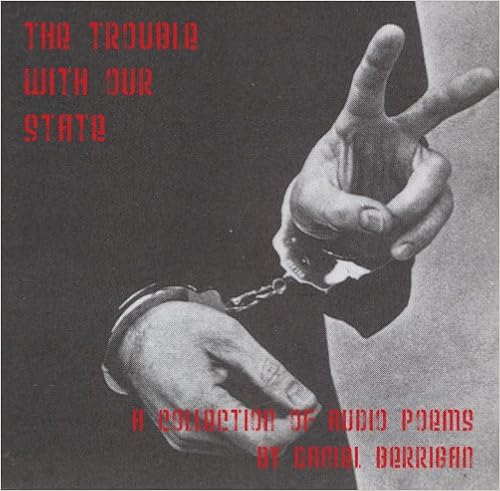
Daniel Berrigan, R.I.P.

"The Trouble With Our State" poems by Daniel Berrigan


Peace Prayer Protest


He was the priest-poet of peace,
Daniel Berrigan was, a saintly soul
Along with his brothers Philip and Jerry
And assorted fellow religious peaceniks
Who went to jail for their beliefs,
Doing Plowshares protests of war machines.

Daniel prayed to stop deliberate destruction.
Did God ever stop and listen?
Daniel protested war and bad faith in pretenses of peace.
Did God hurl thunderbolts? Flood battlefields?
Daniel Berrigan prayed, protested, hurled poetry
At the worshipers of war.
Did God receive him into heavenly peace?


--Jan Barry
 

Thursday, March 17, 2016

Dioxane: Latest Hidden Health Threat

Paint sludge in stream by Ringwood State Park, 2005     (photo: Jan Barry)

Across America, government officials have a terrible track record on leveling with residents about toxic substances in our food and water. From pesticides in food to lead in drinking water, officials are generally quick to dismiss public concerns.  

Recently, a crowd of upset residents in Ringwood, NJ was assured by EPA officials that the finding of suspected cancer-causing dioxane in water in their community poses no immediate health threat.

Residents of the former iron mining community in Upper Ringwood, where Ford Motor Company dumped paint sludge and other toxic waste decades ago, were told that the latest hazardous contaminant to be found in their midst is at very low levels in a closed mine and local streams.

What federal Environmental Protection Agency officials didn’t tell the 200 or so people crammed into the Ringwood borough council chambers is that Americans are virtually swimming in this dangerous chemical—which is in soap and numerous other household products and increasingly showing up in rivers and ground water across the nation.

A plume of dioxane-tainted ground water under Ann Arbor, Michigan, for instance, forced the closure of a city well and created concerns that the contamination may reach the Huron River and threaten the city’s main drinking water source, a local news agency, Mlive, reported in January. 

Dioxane Linked to Cancer and Kidney, Liver Damage

Studies with test animals found that, over time, breathing fumes or drinking contaminated water or having skin contact with 1,4-dioxane causes liver and kidney ailments, including cancer, the federal Agency for Toxic Substances and Disease Registry stated in a 2007 assessment of this chemical, which is used as a solvent and in the production of many household products, including food.

“Human exposure to 1,4-dioxane may occur by inhalation, ingestion, and dermal contact,” the report continued. “Because 1,4-dioxane may be found in tap water, human exposure to 1,4-dioxane may also occur during activities such as showering, bathing, and laundering.” the report added.

Besides what may be in the water, the report adds, “some cosmetics, detergents, and shampoos may contain 1,4-dioxane at levels higher than recommended by the FDA for other products.”

This synthetic industrial chemical is so widespread in American life that it is showing up in the discharge of sewage treatment plants, which often flow into rivers supplying drinking water to downstream communities. 

A North Carolina newspaper, The Courier-Tribune, reported last month that dioxane “became of interest in North Carolina after officials statewide conducted EPA-mandated tests ... Studies showed that Fayetteville and other communities along the Cape Fear River downstream of the Triad had elevated levels of 1,4 dioxane in drinking water drawn from the river.”

“Subsequent research traced much of the problem back to wastewater treatment plants in Greensboro, Asheboro and Reidsville along the Haw and Deep rivers that feed into the Cape Fear. The plants were releasing 1,4 dioxane in their treated sewage.”

The implication of such reports surfacing across the country is that the federal government has been slow to alert the public to what its health agencies have found to be a likely cause of cancer in people.

One observer at the EPA meeting in Ringwood raised an additional health risk factor.

“You’re not talking about the synergistic effect of this chemical combined with other chemicals and metals,” said Judith Zelikoff, a New York University environmental scientist who is doing a health study of area residents. “People I talk to have kidney problems,” Zelikoff added.

Previous water tests in the Ringwood Mines Superfund Site have repeatedly found elevated levels of benzene, lead and other hazardous substances. Under EPA oversight, Ford has fitfully removed tons of contaminated soil from the 500-acre site since the late 1980s. Tons more of industrial debris remain in old mine shafts and a landfill next to state parkland.

Several hundred people, many of them Ramapough Mountain Indians, live in the former mining community or moved elsewhere after growing up during the time industrial waste contaminated soil and water in the mountain area next to Ringwood State Park. Streams from the area flow to the nearby Wanaque Reservoir, the primary water supply for millions of residents in North Jersey.

EPA official assured the crowd, which included elected officials from Bergen and Passaic counties, that tests of the water at the reservoir water treatment plant had not found dioxane.

However, they reported that recent tests found dioxane in Park Brook flowing from the dump site and downstream in Sally’s Pond, a picturesque fishing spot by Ringwood Manor, an historic building in Ringwood State Park. Water from the pond flows into the reservoir.

“Our people drink from the springs, from the streams,” said Vincent Mann, a sub-chief of the Ramapough Indians, referring to the outdoors lifestyle of many Ringwood residents who grew up fishing and hunting in the forested Highlands region along the New Jersey-New York border. Mann also raised a concern with EPA officials that hikers in Ringwood State Park also visit the once-remote area.

Joe Gowers, the EPA case manager for the Ringwood Mines Superfund Site, told the crowd that “We believe the 1,4-dioxane has always been here.” It was found at the site in low levels, he said, because “There’s been a change in testing methods.”

He assured the crowd not to worry about these levels, in the range of 140 parts per billion in a mine air shaft full of water to .44 parts per billion in the pond by Ringwood Manor. The EPA has set a health advisory level of 200 parts per billion, he added.

“We have found 5,000 parts per billion in dish detergent,” he said, without elaborating on what that may mean to the average American household.

NJ Lowers Its Safety Limit for Dioxane

With little notice, some government agencies have begun to address dioxane as a health threat. New Jersey recently lowered its health advisory standard for dioxane in groundwater from 10 parts per billion to .4 parts per billion. But that change in a state regulation didn’t make the news. The information was reported to industrial contamination contractors by Cox-Colvin & Associates, a contamination cleanup consulting firm based in Ohio.

“For all active New Jersey sites where 1,4-dioxane is a known or potential contaminant of concern, the use of the new ground water remediation standard is effective immediately upon it’s posting to the NJDEP website (November 25, 2015),” Cox-Colvin noted in an industry newsletter.

“A handful of state governments including California, Colorado, Connecticut, Maine, Massachusetts, New Hampshire, New York, and South Carolina have set advisory levels for 1,4-dioxane in water ranging from 70 μg/L [equivalent to parts per billion] to 0.3 μg/. Until now only Colorado had established an enforceable cleanup standard. With New Jersey and its many chlorinated solvent contaminated sites at the forefront of 1,4-dioxane investigation and remediation, expect the general awareness of this emerging contaminate to increase throughout the country.”


(An earlier version of this essay was published in The Record newspaper on 3/6/16)
Saturday, February 20, 2016

Warrior Writers: Evolving, Involving Way of Addressing War Experiences


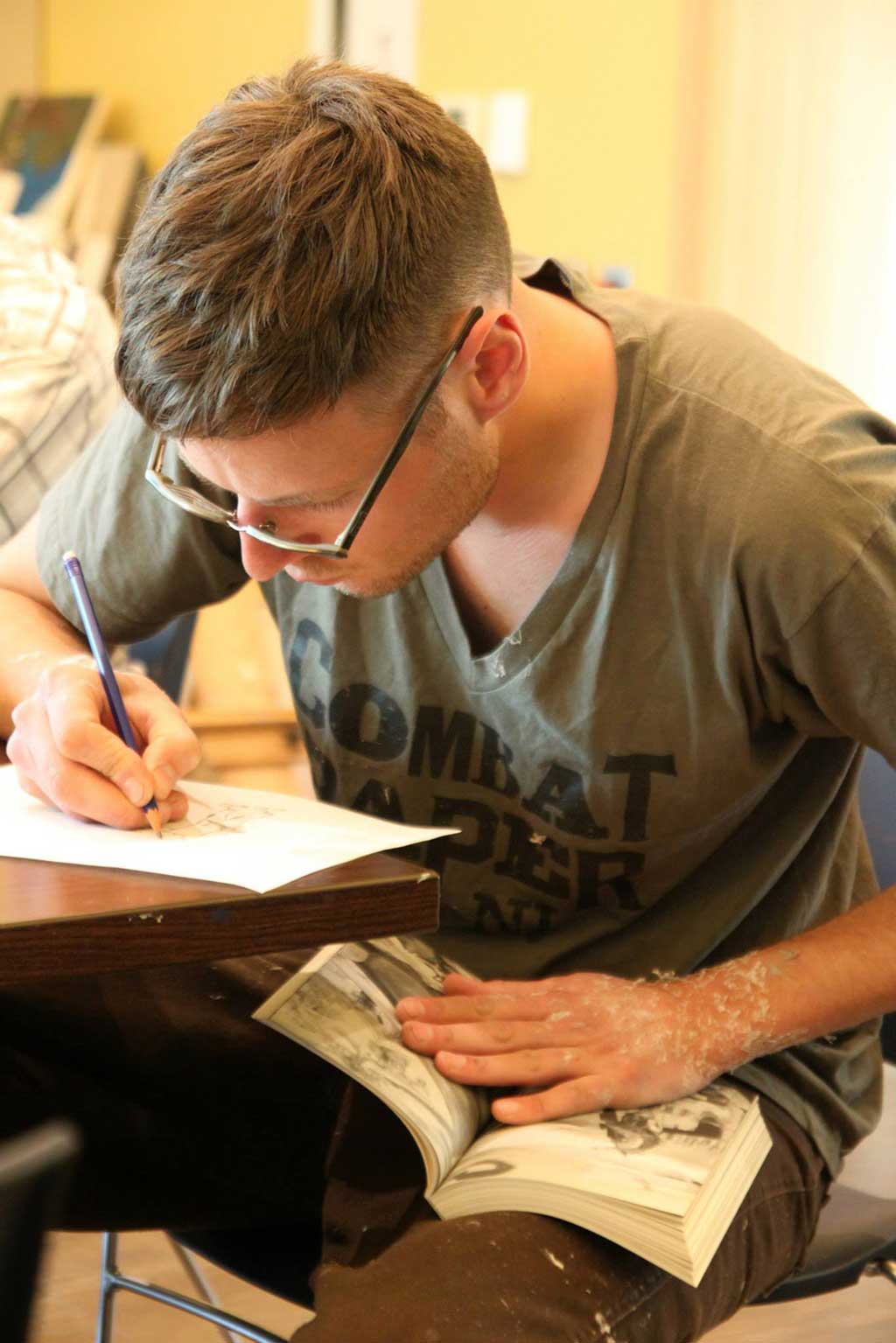
I’ve taught journalism to scores of college students over the past several years as an adjunct professor. It’s hard to say what impact my sharing reporting tips from a decades-long journalism career has had. The newspaper business as a place for writers to work and grow took a tremendous hit in the 2007 recession and from advertising migrating to the Internet. My volunteer work since retiring from the newsroom in 2008, especially my interaction with Warrior Writers and Combat Paper, has been far more satisfying, as I see many participants grow.

Warrior Writers workshops that I help facilitate in New Jersey welcome veterans and military family members. This combination has enriched the discussions at these gatherings. Vets trying to deal with combat experiences and dismay after coming home hear mothers reveal their anguish over a child serving in a war. Parents hear about things in military life that they had no inkling of.

Everyone at these workshops--designed to provide a safe haven for sharing hard to discuss experiences—has witnessed a combat vet choke up while trying to describe something that happened long ago. 

For more than a year, Warrior Writers NJ has held writing workshops in veterans’ homes, informal gatherings that have attracted about a dozen vets and family members to monthly Sunday afternoon get-togethers. The format has also provided a support system for helping to organize poetry readings and art shows in conjunction with Combat Paper NJ, an art group for veterans that works with Warrior Writers on public events.

Since September, Warrior Writers NJ has also provided evening writing workshops once a month at the Geraldine R. Dodge Foundation in Morristown, NJ. This arrangement grew out of Warrior Writers poets being invited to read at the Dodge Poetry Festival in October 2014 at the New Jersey Performing Arts Center in Newark, NJ.

Another evolution in Warrior Writers, which started in Philadelphia, PA in 2007 with a focus on assisting veterans of the War on Terrorism, is that the workshops have also attracted many other veterans who served prior to the 9/11 attacks on the World Trade Center and Pentagon.

“Warrior Writers saved my life,” says Sarah Mess, a New Jersey mother of two who served in a US Army field hospital in the war in Somalia in 1993. She was thrilled by an emotional meeting with another Somalia vet at a recent Warrior Writers workshop. At the same get-together were five Vietnam vets, a Gulf War I vet and the mother of a Marine who served in Iraq.

“The closest I have come to coming home has been in this community,” Sarah Mess said in a video, The Fog of War: Combat Paper and Warrior Writers, produced last year by State of the Arts NJ and shown on NJTV and other educational stations.

Under the direction of Warrior Writers founder Lovella Calica, the group has published four anthologies of writing and art by veterans who participated in workshops. The most recent is Warrior Writers: A Collection of Writing and Artwork by Veterans, published in 2014. The anthology includes the work of more than 70 veterans who served in Vietnam, Gulf War I, Somalia, Kosovo, Afghanistan, Iraq and other nations on military missions.

In a poem titled "Back to Iraq," in the Warrior Writers collection, Army veteran Nathan Lewis describes the process in Warrior Writers workshops of writing about troublesome thoughts. In the last stanza, he writes:

Take the route and go back
Back for one minute
Back for one second
Just for a thought
Just for a memory
The rubble, the smoke, the man with the shovel
I visit them in memory so they don't visit me in sleep

Finding a Creative Community

Kevin Basl, an Army vet who served in Iraq and coedited the Warrior Writers collection, wrote about learning about the program while studying for an MFA in fiction writing at Temple University: “I discovered what I had been lacking: a genuine, face-to-face community where I could share my stories honestly, a place where I could understand my new identity. I found myself surrounded by friends to encourage me both in my art and in processing my war experience, to help rekindle a sense of purpose. This was something essential that no MFA program could provide.”

The Warrior Writers workshop approach has spread across the country, with sessions hosted by art centers, colleges, VA hospitals and military bases. The workshops are run by veterans and supporters under the guidance of Lovella Calica, who periodically offers training workshops in Philadelphia and other locations.

Upcoming Warrior Writers events are scheduled in Boston, New York, New Jersey, Philadelphia, Chicago, Los Angeles, and other locations. Combined workshops will be held with Combat Paper NJ at Walter Reed National Military Medical Center and other locations in the Washington, DC area.

“A lot of the Combat Paper workshops include a writing element based on Warrior Writers’ free writing style. It really is an immediate way to get thoughts and feelings and expression out from your head,” David Keefe, director of Combat Paper NJ and a Marine vet of Iraq, said in The Fog of War video.

Seema Reza, a poet who runs writing workshops for active duty soldiers at Walter Reed National Military Medical Center, wrote an appreciation for the Warrior Writers program as an afterword in the 2014 anthology: “I have used the work from Warrior Writers anthologies in writing groups … and every single time, I witness change and a greater sense of clarity—both in myself and in participants.”


For more information: www.warriorwriters.org


Friday, February 12, 2016

Dust Devils


Dust devil off Route 50 in Nevada, June 2015  (photo: Jan Barry)
 
Route 50 across Nevada,
“Loneliest highway in America,”
They say. No cars or trucks in sight
As I pull to the side for a pit stop.
A dust devil is rising to the north
Way out over Willow Creek Ranch,
As I pee on a  sage bush
Near the sign at the cattle gate.
By my feet, a rusted tin can,
Broken remains of a beer bottle,
Cigarette butts crushed in the sand.

How many times I’ve been
On some road, traveling alone.
I enjoy the silence,
The views, the timelessness,
Communing with Nature.
Soon enough I’ll be back
Amid friends and family,
The whirl of daily life.

 Water spouts swirl to the south.
A ring of magnificent mountains
Embraces the desert basin.
Generations of travelers
Have trekked through here,
Seeking something else.
I’m on the road again,
Looking for the meaning of life.

A dust devil dances
Across the desert
And across the highway,
A whirling dervish
Swirling in front of the car,
Suddenly a bronze-gray ghost
I drive through.
 
--Jan Barry