Friday, September 13, 2013

America Mired in Middle East


As President Obama threatens to smack the militaristic Syrian regime with a missile barrage, a prominent military historian says this is just the latest proof that America’s military might is flailing about in the Middle East.

Addressing the current crisis over the use of chemical weapons in Syria, Andrew Bacevich, a Boston University history professor and retired Army colonel, said on PBS television last night: “if I could have five minutes of the president's time, I'd say, ‘Mr. President, the issue really is not Syria…'"  The real issue, Bacevich said, is that a decades-long campaign "to use military power to somehow stabilize or fix or liberate or transform the greater Middle East hasn't worked.”

Bacevich, a West Point graduate who served in Vietnam, noted the dubious outcomes of numerous US military actions in Muslim nations over the past three decades. 
 

“And if you ... just sort of tick off the number of military enterprises that we have been engaged in that part of the world, large and small, you know, Beirut, Afghanistan, Iraq, Yemen, Somalia, and on and on, and ask yourself, 'What have we got done? What have we achieved? Is the region becoming more stable? Is it becoming more Democratic? Are we enhancing America's standing in the eyes of the people of the Islamic world?'

 "The answers are, 'No, no, and no.' So why, Mr. President, do you think that initiating yet another war, 'cause if we bomb Syria, it's a war, why do you think that initiating yet another war in this protracted enterprise is going to produce a different outcome? Wouldn't it be perhaps wise to ask ourselves if this militarized approach to the region maybe is a fool’s errand.”


The stark reality, Bacevich argued in an extensive discussion on the Moyers & Company program, is that America’s mighty military machinery is stuck in the shifting sands of massive upheaval sweeping the region. Since the 1980s, American leaders "have claimed that we possess the capacity to somehow direct or control these processes of change. Even though the truth is, we don't have that capacity," he said. "The truth is, we are largely irrelevant to what's going on in that part of the world. But if we reach out and, you know, use our military powers to drop some missiles here and there, we can sustain the illusion that we have some kind of relevance.” 


If the United States wants to help the Syrian people caught up in a brutal civil war, Bacevich continued, “why is peppering Damascus with cruise missiles the best way to demonstrate that concern?”


“I mean, a little bit of creative statesmanship it seems to me might say that there are other things we could do that would actually benefit the people of Syria, who are suffering greatly, who are fleeing their country in the hundreds of thousands. Who are living in wretched refugee camps. Why don't we do something about that? Why wouldn't that be a better thing to do from a moral perspective than bombing Damascus?”


Bacevich is the author of several books—including Limits of Power—critical of what he sees as American militarism run amok.He is particularly critical of the war in Iraq, in which his son died on a military mission. “Now some number of Americans paid for that disaster in terms of soldiers killed, lives shattered,” Bacevich said. “Far, far greater numbers of Iraqis paid for that disaster and are still paying for that disaster. So the conversation about Syria is far too narrow. It needs to be expanded to include some of these other military misadventures that we have undertaken.”


For more information:
billmoyers.com/segment/andrew-bacevich-on-taking-action-in-syria/


Monday, September 2, 2013

War or Diplomacy


As we celebrate the Labor Day holiday, Americans should thank our lucky stars that we’re still around. America as we know it nearly ended in October 1962. That’s when the US military squared off against Soviet forces in the Cuban Missile Crisis.

Long before President Obama proclaimed a “red line” in Syria, President John F. Kennedy drew one around Cuba. In the end, World War III was narrowly averted by back door diplomacy.

The Soviet Union is no longer around, but Russia inherited its nuclear weapons. And Russia’s leaders back Syria’s government, which Obama is threatening to “punish” with a military attack. Getting into a proxy war with Russia in the Middle East could well revive the most dangerous times of the Cold War nuclear age.

Furthermore, Syria and its regional allies previously devastated a US military force sent to send them a message.

“At this time of crisis, it is worth remembering another time, 30 years ago in October, 1983 when U.S. warships bombarded Lebanon, the country located next to Syria,” retired Col. Ann Wright wrote recently. “Within weeks, the U.S. Marine barracks in Beirut was blown up by a massive truck bomb that killed 241 American servicemen: 220 Marines, 18 sailors and three soldiers. The truck driver-suicide bomber was an Iranian national named Ismail Ascari … Two minutes later a second suicide bomber drove a truck filled with explosives into the French military compound in Beirut killing 58 French paratroopers.”

The explosive blowback against US military posturing aimed at countering Syria’s influence in Lebanon also destroyed US diplomatic work in the region. Wright, a former diplomat as well as Army officer, noted:

“Earlier in the year, on April 18, 1983, the U.S. Embassy in Beirut had been blown up by another suicide driver with 900 pounds of explosives that killed 63 people, 17 Americans, mostly embassy and CIA staff members, several soldiers and one Marine, 34 Lebanese employees of the US Embassy and 12 Embassy visitors. It was the deadliest attack on a U.S. diplomatic mission up to that time, and marked the beginning of anti-U.S. attacks by Islamist groups. The U.S. and French military were in Lebanon as a part of a Multi-National force after the PLO left Lebanon following the 1982 Israeli invasion of Lebanon. ostensibly to create a 40 km buffer zone between the PLO and Syrian forces in Lebanon and Israel.”

US military forces withdrew from Lebanon and diplomatic efforts sputtered out. Three violent decades later, Obama aims to fire cruise missiles into Syria to teach them a lesson, a move that could backfire in explosive ways that wreck peacemaking work in the region for another generation.

If Obama intends to resolve this long-simmering crisis, rather than inflame it, he should read a perceptive account in The Atlantic of how Kennedy ultimately used diplomacy in the Cuban Missile Crisis:

“Plainly shaken by the apocalyptic potentialities of the situation, Kennedy advocated, in the face of the bellicose and near-unanimous opposition of his pseudo-tough-guy advisers, accepting the missile swap that Khrushchev had proposed [that the US remove its nuclear missiles from the Soviet border area in Turkey in exchange for Soviet missiles being shipped back from Cuba]. …”

Obama should continue reading how Kennedy hid this diplomatic deal from the American public, so that he would look tough militarily.

“Although Kennedy in fact agreed to the missile swap and, with Khrushchev, helped settle the confrontation maturely, the legacy of that confrontation was nonetheless pernicious. By successfully hiding the deal from the vice president, from a generation of foreign-policy makers and strategists, and from the American public, Kennedy and his team reinforced the dangerous notion that firmness in the face of what the United States construes as aggression, and the graduated escalation of military threats and action in countering that aggression, makes for a successful national-security strategy…”

As the author of The Atlantic article, Benjamin Schwarz, noted:

“This esoteric strategizing—this misplaced obsession with credibility, this dangerously expansive concept of what constitutes security—which has afflicted both Democratic and Republican administrations, and both liberals and conservatives, is the antithesis of statecraft, which requires discernment based on power, interest, and circumstance.” 


The lesson of the Cuban Missile Crisis that Kennedy muddled is that diplomacy is a far better bet than waging war—and it takes more courage to do peacemaking than doing puffed chest posturing to look warrior-like.

For more information:


Saturday, August 31, 2013

Waging War on Peacemakers

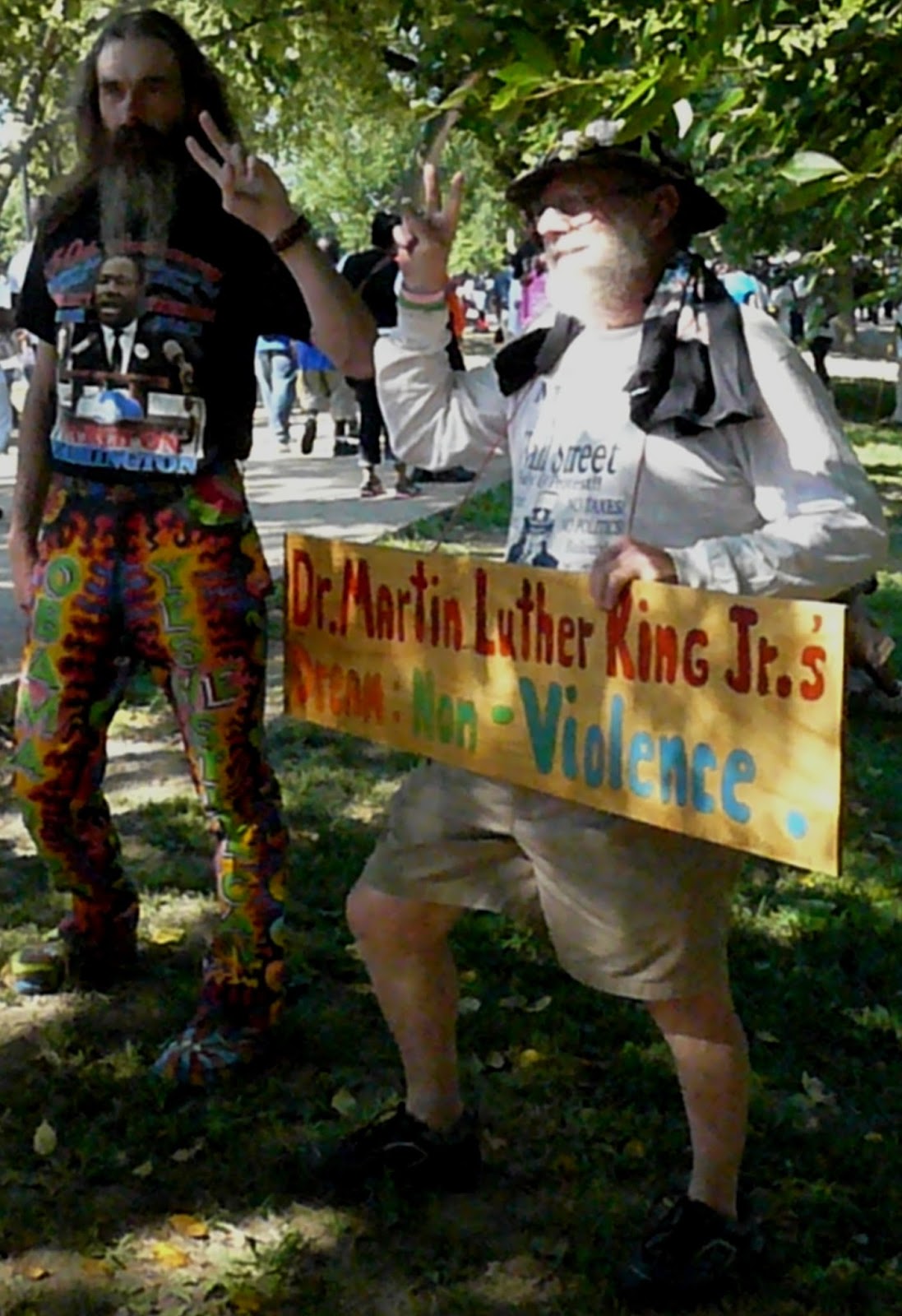
Vietnam vet Frank Wagner at March on Washington 8/24/13


That the Obama Administration is set on waging war in yet another nation, amid national celebrations of the 1963 March on Washington, is beyond bizarre. It is a betrayal of everything Dr. Martin Luther King Jr. and fellow peaceful demonstrators stood for 50 years ago and since.

On Wednesday, speaking to the crowd at the Lincoln Memorial, President Obama invoked much of Dr. King’s stance on civil rights, but pointedly ignored the major theme—nonviolence—of his life.

Instead, Obama spent most of the week preparing public opinion for his plan to launch a military attack on Syria—even as his administration is still entangled in violent whirlwinds from its military actions in Iraq, Afghanistan, Pakistan, Yemen, Libya and enabling support for the military regime in Egypt that violently overthrow a democratically elected president and killed hundreds of nonviolent protesters.

Had he truly wished to honor Dr. King, Obama could have done so with an appropriate quote, such as this:


“Why are you speaking about war, Dr. King? Why are you joining the voices of dissent? Peace and civil rights don't mix, they say. Aren't you hurting the cause of your people, they ask? And when I hear them, though I often understand the source of their concern, I am nevertheless greatly saddened, for such questions mean that the inquirers have not really known me, my commitment, or my calling. Indeed, their questions suggest that they do not know the world in which they live.”


And if Obama were truly aware of his administration’s reckless continuation of the violent American tradition of waging war on other people, from Native Americans to other nationalities around the world, he could have cut to the chase and quoted this statement by Dr. King:


“I knew that I could never again raise my voice against the violence of the oppressed in the ghettos without having first spoken clearly to the greatest purveyor of violence in the world today--my own government.”


Yet even with a once-dissident Vietnam veteran as his Secretary of State and another once-outspoken-on-the-costs-of-war Vietnam vet as Secretary of Defense, Obama has mounted the bully pulpit and brushed aside the searing lessons of the Vietnam War’s disastrous effects at home to pursue yet another in a series of ruinous war policies.

Apparently, Obama never studied Dr. King’s career after 1963. Apparently, he never studied nonviolent conflict resolution. Apparently, he never consulted fellow Nobel Peace Prize recipients on how to end wars, rather than enflame them.

Otherwise, this president—who campaigned to end the war in Iraq, but then widened US military actions into other Muslim nations—would be challenging fellow Americans to live up to the fullness of Dr. King’s dream, as expressed in numerous sermons and public statements on the Vietnam War. If Obama truly honored the change in America that Dr. King lived and died for, he would channel the man who said this of waging war:


“The Western arrogance of feeling that it has everything to teach others and nothing to learn from them is not just. A true revolution of values will lay hands on the world order and say of war, ‘This way of settling differences is not just.’ This business of burning human beings with napalm, of filling our nation's homes with orphans and widows, of injecting poisonous drugs of hate into the veins of peoples normally humane, of sending men home from dark and bloody battlefields physically handicapped and psychologically deranged, cannot be reconciled with wisdom, justice, and love. A nation that continues year after year to spend more money on military defense than on programs of social uplift is approaching spiritual death.”


Instead, the Obama Administration has aimed and fired America’s military weapons at people around the world, aimed its national security apparatus at fellow Americans at home and abroad, prosecuted and persecuted whistle-blowers who sought to inform the public of what the government is doing, supplied and enabled state and local police to repeatedly assault peaceful demonstrators, including dissenting veterans of Obama’s wars, and continued waging year after year a brutal war in Afghanistan that is daily, in Dr. King’s phrase, “sending men home from dark and bloody battlefields physically handicapped and psychologically deranged.”  

President Obama does not wear the mantle of Dr. Martin Luther King Jr. Increasingly, he has acted like Lyndon Baines Johnson—whose bull-headed presidency wrecked social welfare programs at home in the pursuit of  a monstrous war in Vietnam—and Richard Nixon, who waged war on fellow Americans protesting his expansion of war, combined.   

For more information:


Monday, August 26, 2013

March on Washington 2013


Marchers in Washington, August 2013           (photo/Jan Barry)


I missed the historic March on Washington led by Dr. Martin Luther King Jr. and other civil rights leaders in August 1963. I was on military missions in Vietnam that summer. So I went this year with friends and neighbors to the 50th anniversary march celebration that filled much of the Mall in Washington on Saturday.

At least two other Vietnam veterans were on the bus that departed from Englewood, NJ well before dawn with 50-some community activists organized by the Bergen County NAACP. Others ranged from 98-year-old Mary Shoiket and 73-year-old Melinda Bonner, who each participated in the 1963 march, to young people born long after the tumultuous 1960s.

In Washington, the marchers streamed from rows and rows of buses that pulled into the RFK Stadium parking lots and, in high spirits, began a long walk to the Metro station, whose trains conveyed a growing mass of people of every age and ethnicity that emerged in downtown Washington and converged on the Reflecting Pool area in front of the Lincoln Memorial.

To say this brought back a swirl of memories is an understatement. One of the legacies of the 1963 march was the proliferation of peace marches in Washington to protest the war in Vietnam and subsequent wars waged by the US overseas. I’ve lost count of how many peace marches in Washington I participated in after I got out of the Army.

A major theme of the 2013 March on Washington, which is officially commemorated on Wednesday, is how much still needs to be done to fully bring about the goals of the 1963 march, which focused on key civil rights issues of voting rights and equality in employment for African-Americans.

Few of the signs and speakers on Saturday raised Dr. King’s other major concern of the 1960s: the destructiveness of militarism on American society.

“Wage Peace!” a young woman shouted from the crowd on spying my Veterans for Peace button with that slogan on my hat. It was hard to judge how much that theme was an additional factor in motivating tens of thousands of people to peacefully assemble in the nation’s capitol to express support for Dr. King’s “I have a dream” speech.

As many commentators noted in reviewing the legacies of the 1963 march, Dr. King’s full-throated protests of injustices at home and, in later years, in America’s war in Vietnam are generally reduced in the media to a few visionary phrases from one portion of his speech on the steps of the Lincoln Memorial.

I never heard Dr. King’s words until long after I saw injustices that he was calling out.

The peaceful scene on the Mall in Washington on Saturday, and in recollections of the march in 1963, contrasted vividly with my memories of nonviolent  Buddhist marchers confronted in Vietnam by armed soldiers—an army that the US military supplied, trained and supported in violently attacking fellow Vietnamese.

My enduring memory of Washington in 1963 was witnessing, as a recently returned war veteran, the public outpouring of shock and grief in the streets around the White House after the assassination of President John F. Kennedy in November—just days after the South Vietnamese president that Kennedy had supported was killed by South Vietnamese military leaders that our military mission had trained.

Barely a year later, I was stationed at an Army base in Alabama not far from the Selma-to-Montgomery voters-rights march route that became infamous when state police attacked nonviolent marchers, Klan members shot and killed a woman assisting marchers, and the US military was ordered to protect the civil rights demonstrators.

Behind the scenes of armed white men intent on blocking black men and women from registering to vote, another drama of historic dimensions was playing out. As Army units at Ft. Rucker, Alabama, were preparing fleets of helicopters for a massive invasion of combat-trained troops to greatly expand the war in Vietnam, a soft-spoken college professor teaching a course in psychology on base made the biggest impression on me.

Introducing himself to a classroom full of soldiers, the professor said he’d returned from a well-known university in the North to teach at a state college in Alabama. The reason, he said, was to help change minds of his fellow Southerners at a crucial point in American history. It was, I thought at the time—and still do—the most courageous thing I’d seen in my military experiences.

So I was especially glad to see many folks wearing teachers’ union and college group t-shirts and brandishing educational signs among the marchers in Washington this weekend.

America has not fared well in our violent tradition of arming, training and supplying armies around the world—from Vietnam to Afghanistan, Iraq to Egypt and elsewhere. But our nation over the past half-century made a great sea change in many areas of life at home, thanks to preachers and teachers. And the civil rights and fellow civic movements that brought this about didn’t fire a shot.

“We must not forget that Dr. King stood before and with thousands, the people who made the mighty movement what it was … they provided the foot soldiers of the freedom army,” civil rights veteran Julian Bond told the crowd on Saturday.
“They shared with King an abiding faith in America. They walked in dignity rather than ride in shame. They faced bombs in Birmingham and mobs in Mississippi. … They marched, and they organized. Remember, Dr. King didn’t march from Selma to Montgomery by himself. He didn’t speak to an empty field at the March on Washington. There were thousands marching with him and before him, and thousands more who did the dirty work that preceded the triumphal march. The successful strategies of the modern movement were litigation, organization, mobilization and coalition—all aimed at creating a national constituency for civil rights.”  
    
Along with a string of other noted speakers, Attorney General Eric Holder exhorted the crowd to continue on this course:  “As we gather today, 50 years later, their march is now our march, and it must go on. And our focus has broadened to include the cause of women, of Latinos, of Asian Americans, of lesbians, of gays, of people with disabilities, and of countless others across this great country who still yearn for equality, opportunity and fair treatment.”

For more information:
                

Friday, August 23, 2013

Fun and Death on the Delaware


Tubing on Delaware River, August 2013          (photo/Jan Barry)


Drownings in the Delaware River’s popular tubing and white-water canoeing and kayaking stretches are running high this summer. Yet the deceptively swift, cold water coursing between New York, Pennsylvania and New Jersey draws crowds of fun-seeking visitors on sunny summer days.

My partner Paula and I went rafting down the Delaware last week amid a flotilla of families and couples in gaily colored tubs, many with their life vests casually hooked to the tub as they bobbed through riffles and white-water stretches.

Paula was nervous about making this seemingly lazy outing on a scenic river, after hearing that a young man had recently drowned in this section. I assured her that a rubber raft is very stable and that, furthermore, we would also keep our life vests on. Besides, I assured her, I’ve canoed, kayaked and rafted on this river for decades without a problem.

After basking in the sun while the raft bobbed gently along, I decided to cool off and flipped into the water—which was so cold it took my breath away. The raft shot downstream. I had to paddle hard in the life vest to catch up with it. For awhile, I happily floated in the river with one hand on the raft, feeling greatly refreshed.  

Trying to stand in neck-deep water to get leverage to climb back into the raft, my feet were swept and dragged over slippery rocks by a relentless, powerful current. Suddenly, I realized how someone without a life vest and nothing to grab onto could be in serious trouble.

Still, little did I fully appreciate that our fun-loving flotilla was floating down a particularly deadly river for the unwary.

At least six people have drowned or disappeared in the Delaware River this summer, according to news reports, in a season of deeper water and faster currents after frequent rainstorms. But that’s just the tip of a long, grim toll of frolicking-turned-tragedy.       

“Records from the Delaware Water Gap National Recreation Area show that since 1971, when the park began keeping statistics, 89 people have drowned in the 40-mile stretch of water running from near Milford, Pa., south to Portland,” The Express-Times of Easton, Pa. reported Monday.

“Not one victim was wearing a properly fitted life jacket, said park spokeswoman Kathleen Sandt. ‘That is absolutely one thing that you can do to help keep yourself and your family safe: Wear a properly fitted, United States Coast Guard-approved life jacket at all times,’ she said.”

Meanwhile, in the Upper Delaware Scenic & Recreational River national park above Milford, Pa, “64 people have drowned in the federal park's 73 miles of water since 1980. Sixty of them were men between the ages of 18 and 30 years old, statistics show,” The Express-Times reported.

"Maybe it's peer pressure. Maybe it's that men are more apt to partake in risky behavior,” Kevin Reish, water safety coordinator for the Upper Delaware Scenic & Recreational River, told The Express-Times. “But I wouldn't say they are more likely to wear a life jacket.”

In our flotilla group, which launched from a state park boat ramp near Frenchtown, NJ, few women or men kept their life jackets on. At the first rapids, two teenage boys horsed around, climbing, sitting and standing on jagged boulders amid a churning swirl of white water. Further downstream, another youngster wading in chest-deep water nonchalantly watched his life vest float away on the fast-moving current.

This summer, park rangers and police in river towns have stepped up a public education campaign to warn visitors of the river’s dangers and to keep life vests on. Additional river safety tips provided by the National Park Service include:

“Never try to stand in rapids. Your foot could become trapped between submerged rocks. The current can be strong enough to push you over and hold you under even if you are wearing a life jacket…

“Wear your life jacket even when swimming. Most drownings occur when boaters stop and swim. Never swim alone!

“Do not overestimate your swimming ability. Do not attempt to swim or wade across the river. The Delaware River has strong currents and steep drop-offs. Swimming becomes more difficult with increased current and water depth.”

For more information:


Friday, August 9, 2013

A General Who Championed Dissent


Douglas Kinnard fought in three wars, retired as a brigadier general and began studying dissent. That was in 1970, when the high-flying West Pointer turned down a promotion after his second tour in Vietnam and returned to college to study for a Ph.D at Princeton. Like many other colleges, the Ivy League campus in New Jersey was in turmoil as students and faculty passionately protested the expansion of the war in Vietnam into Cambodia.

Kinnard, who had harbored private doubts about the war while in uniform, said in an interview years later: “I think that the people who demonstrated against the war … frankly, I think they did the country a great service.”

Asked what, in subsequent years, he taught his political science students at the University of Vermont about the Vietnam War, he said: “I taught them that it was a war that should not have been fought.”

Kinnard, a native of Paterson, NJ, who died July 29 at age 91, after Army service in World War II, Korea and Vietnam, was widely known as an author of military histories that reexamined established views. His obituary in The Record of North Jersey noted that he “ruffled the military establishment with his 1977 book ‘The War Managers,’ which asserted that the majority of generals who served in Vietnam from 1965 to 1972 were critical of how the war was run and, in retrospect, regretted U.S. involvement.”

According to The Record obit, Kinnard’s son, Frederick, said his father “also disagreed with the U.S. invasion of Iraq after 9/11. ‘He was extremely critical of going to war,’ the son said. ‘He felt that is the very last thing you do.’”

Kinnard was the author of several books, including an autobiography titled Adventures in Two Worlds: Vietnam General and Vermont Professor.

An insightful interview on Kinnard’s transformation from soldier to war critic can be found at:


Wednesday, July 10, 2013

July 4th Fireworks


Washington, NJ  7/4/05        (photo/Jan Barry)

I’ve enjoyed July 4th fireworks in many places over the years, from a tiny coastal town in Maine to New York City extravaganzas. But for some reason, I flinched more than usual this year, sitting in a lawn chair in a neighborhood park watching the vibrant, earth-shaking airbursts that delighted the crowd of local families.

Checking Facebook later, I found I was scarcely alone in feeling jumpy amid one of America’s favorite celebrations.

“This was the worst 4th of July yet,” an Iraq war veteran wrote,” and before you knew it, we got caught in early fireworks from one of the parks over the hill. The new dog, Moxie was terrified. BOO was freaked out too, I realized I was able to shelter him from fireworks his whole life except this year. I was jumping out of my skin even with the ear plugs in…”

On the Warrior Writers site, this message popped up: “I am celebrating this 4th of July by returning to Afghanistan. My mind is on edge and I can't sit still. This anxiety from the pop pop pops of fire crackers and booms of fireworks. Every sudden shot makes me jump…”

A Vietnam vet replied:  “Bro, I've jumped twice tonight in my house from the sound of fireworks…”

Besides outbursts by vets on Facebook, some thoughtful news providers alerted the public to this issue.

“Fourth of July is one of the loudest holiday celebrations of the year. As many of us prepare to celebrate the patriotic holiday, many veterans are preparing for the worst. Something as innocent as a fireworks display can trigger painful memories of the past,” KOLO television in Reno, Nevada reported on July 3.

“The explosive pops and booms of colors usually indicate a celebration, but they send army veteran, Michael Wells' heart racing. ‘You hear that boom boom and you're back in combat mode and freaking out,’ he said.”

And it’s not just the big official fireworks displays that unsettle many vets.  “My neighbor just started lighting up fireworks, the boom, boom, boom, I was freaked out for over an hour," Wells said. "I was shaking and couldn't really get back into it cause you know I was right there and it was so loud. When we got hit with mortars that's what it took me back to."

A public health doctor at George Washington University posted a Science Blog with suggestions on what folks who want to celebrate with fireworks can do to minimize the impact on neighbors who served in war zones.

“The National Fire Protection Association and the American Academy of Pediatrics’ teamed up to form the Alliance to Stop Consumer Fireworks. They argue that fireworks displays should be organized and managed by trained professionals, not neighborhood fire bugs,” wrote Dr. Celeste Monforton. “… For veterans and others suffering from PTSD, a ban on consumer fireworks would provide some relief.  They wouldn’t have to dread and suffer the consequences of impromptu blasts of fireworks in their neighborhoods, while taking steps to avoid the noise from their town’s scheduled public fireworks displays.”

For more information: