Monday, June 30, 2014
From War to Peace Poet
Not many poets these days embrace being peace activists. Based on poems published in popular magazines, readers would have no clue what contemporary poets think about Americans’ addiction to waging—and continually celebrating—an endless litany of wars.
Doug Rawlings embraces being a poet and a leader of Veterans For Peace. His new book, Orion Rising: Collected Poems, is dedicated to his family and the veterans’ organization founded in 1985 by Rawlings and other former soldiers. Over time many others, including me, signed up as well.
I first encountered Doug Rawlings’ soul-shaking poetry on surviving an Army tour in Vietnam just as that war was ending. Several of his poems graced Demilitarized Zones, the anthology of angry verses by Vietnam vets that W.D. Ehrhart and I published in 1976. At the time, he was teaching high school English in Maine. Publication of those early poems, he notes in his recently self-published book, gave him a social and literary grounding.
Over the years, as his teaching path led to the University of Maine, he continued writing poetry and persistently advocating for peaceful resolutions of the far-flung wars that the United States insists on partaking in.
“As a veteran,” he writes in his book dedication, “I feel a specific obligation to bring back old memories, to rekindle anguish and despair long buried, and to speak out against this military madness that has so grotesquely distorted our past, that is tearing apart our present, and that threatens to extinguish our future.”
In his collected poems, Doug Rawlings confronts the worst of life, and celebrates the best of life, in poems that transform calcified clichés into lightning bug flashes of insight, foresight and delight. His war poetry punctures the patriotic balloon that imploded amid soldiers in Vietnam. His political poetry turns home front homilies into trumpet calls for peace campaigns. And his poet’s gaze on family, friends and nature—from his corner of Maine to the star-spangled universe—is no less, quite often, breath-taking.
In “Low Intensity Warfare,” for instance, he contrasts the atmosphere in North America—“Up here/ fall is in the air/ the mornings are crisp and clear”—to that in parts of Central America torn by civil wars stirred by US military and economic exploitation: “Down there/ young peasants/ are slipping into puddles/ of mangled skin…Down there/ the morning air/ smells of burning flesh…”
Doug Rawlings’ alternative way of life, embraced by many war veterans, is conveyed in his poem “Flower Song”:
Live your life
like a flower
Blossoming every hour
Reaching for the sun
Growing with the rain
Living every moment
like it’ll never come again
Orion Rising, which includes artwork by neighbors and friends Carol Scribner and Rob Shetterly, can be ordered through lulu.com, the online publisher.
Monday, June 9, 2014
Medicine Garden
A stone’s throw from the Ramapo
River, a cheerful crowd of Native
Americans and local supporters gathered Sunday to plant a medicine garden on a patch
of cleared ground in Torne
Valley where Ford Motor
Company recently removed tons of toxic paint sludge.
The traffic roar on the nearby New York State Thruway evaporated
as Native American drums and songs arose as though from the distant past to accompany
garden dedication ceremonies, including sharing pinches of tobacco sprinkled
into a fire and the planting of plugs of Sweet Grass. The roughly half-acre site
in a former sand and gravel quarry is laid out for growing Sweet Grass and
Sage, used for basketry and smudging, as well as “healing herbs beneficial for
cancer patients,” according to the invitation.
Two turkey vultures circled overhead, looking for road kill
along the highway and railroad corridor that cuts through the once bucolic gap
in the Ramapo Mountains. One speaker noted with a
chuckle that vultures are symbols of recycling.
The Healing of the Earth Ceremony marked a long-haul, grassroots
effort by local residents and environmental activists to get Ford to remove the
lead and chemical solvents-tainted waste, which was trucked from Ford’s Mahwah
assembly plant and dumped along riverbanks in the 1960s. The buried debris in
this field was next to a well that provides drinking water to much of the area
around Suffern, NY. Further downstream are wells serving
Mahwah and other towns in New Jersey.
“Today, with this healing ceremony, it’s a tipping point”
toward protecting the environment in the bistate Ramapo River watershed, said Christopher
St. Lawrence, the Town of Ramapo Supervisor, whose municipal government successfully
pressed for clean up work that New York state officials let slide for decades despite
repeated calls from area officials.
“This was ground zero for the buried lead paint,” said Chuck
Stead, a Ramapo College adjunct professor and an environmental
educator with Cornell Cooperative Extension of Rockland County. As a
result of work that he and his students did over several years in mapping
buried debris locations and filing reports with local and state agencies, Ford
contractors last year removed 42,000 tons of tainted soil and hazardous waste
from the Ramapo River well field parcel.
Stead lauded the Detroit-based auto company for eventually taking
that action, planting dozens of native trees on the well field tract and paying
for a sturdy deer-resistant fence around the medicine garden plot. But each of
these steps, he noted, required persistent discussions and negotiations.
New York State Department of Environmental Conservation
officials are now overseeing a similar remediation plan for Ford to excavate
and remove more toxic waste along Torne Brook, a nearby tributary of the Ramapo River.
Dwaine Perry, chief of the Ramapough-Lenape Nation, who
lives in the adjacent village
of Hillburn, NY, thanked
a number of the people at the ceremony for their combined efforts. “The one
message that comes through is persistence, persistence, persistence pays off,”
said Perry. He added that Ford’s work on this site “hopefully is the beginning
of corporate decency” on environmental issues nationally.
“Be proud that you live in a town that supports you,” said
Vivian Milligan, a leader of the Ramapough community in Ringwood, NJ,
where another Ford dump site is partially cleaned up. “Hopefully, some day we
will have a garden in Ringwood.”
St. Lawrence, whose sprawling Rockland
County town stretches along the border
with New Jersey
within miles of Ringwood, added in his remarks: “We need to all come together
and work on Ringwood.”
Thursday, May 29, 2014
Fishing Story
Friday, May 16, 2014
Seeing Lou Grant
| Lou Grant (photo: Wikipedia) |
I wrote on my calendar for May 15 that I was going to see Lou Grant.
And so we arrived at the Bergen Performing Arts Center to see Ed Asner in his cross country, long running presentation of his one-man show, FDR. As the largely elderly audience was still settling in, Asner abruptly took the stage in a wheelchair, and then stomped about on a pair of canes and presented a very compelling characterization of the polio-crippled President who forcefully led the country through the crises of the Great Depression and World War II, despite formidable political foes and the howling hounds of the press.
As the FDR show wrapped up to a big round of applause, I was still looking for Lou Grant—the curmudgeonly, get-that-story, and get-it-right newspaper editor Asner played on television in the 1970s and early 1980s. That TV character was perhaps the biggest influence on my then-budding career as a journalist.
In Lou Grant’s world, journalists suffered crises in their own lives, but still got out there and pinned down the facts of events, on deadline, that were important for the public to know about. “The series frequently delved into serious societal issues, such as nuclear proliferation, mental illness, prostitution, gay rights, capital punishment, child abuse, and chemical pollution, in addition to demonstrating coverage of breaking news stories such as fires, earthquakes, and accidents of all kinds,” a Wikipedia description astutely noted.
“The Lou Grant show ran from 1977 to 1982 and became the most popular newspaper drama ever broadcast on television,” noted a review in Booklist of “Lou Grant,’ a book about the show. “Journalists at the fictional Los Angeles Tribune strove to question authority while covering issues as thoroughly as possible. … often reflecting real news of the day, from Vietnam vets and inner-city school violence to political corruption and homosexuality … For five seasons, Lou Grant and his colleagues delivered a weekly dose of dramatic realism …”
And then CBS abruptly cancelled the program. “In the later years of the series, Asner became known for speaking out on numerous social and political topics, especially in opposition to the U.S. involvement in Central America. The show was canceled in 1982, reportedly due to poor ratings, while some—including Asner—have speculated that the actor's activism may have influenced the decision to end the series,” according to biography.com.
The Lou Grant show roughly coincided with my first stint as a daily newspaper reporter. After getting laid off in 1980, in the wake of writing an investigative series about Vietnam veterans’ emerging health concerns about Agent Orange and other chemicals used in the war, I had more time at home to study how Lou Grant’s savvy newsroom covered controversial issues.
Then, getting involved in grassroots activism with a local peace group countering the Reagan Administration’s nuclear missile-rattling with the Soviet Union and military moves in Central America, I appreciated Asner’s outspoken stance on these and other issues. This provided additional inspiration in my life.
Three decades later, I heard Ed Asner was coming to do a show in a neighboring town. What I felt was that Lou Grant was coming to town.
Turns out that my partner, Paula Rogovin, knew Asner through her family’s network of activism. So we were invited to meet him backstage. So was a bunch of other people Asner had meet over the years, including a family that knew him growing up in Kansas City, Missouri. Herded up into a bare dressing room in the old vaudeville theater in Englewood, NJ that was saved by a civic campaign, I wasn’t sure what to expect.
| Ed Asner in Englewood (photo: Paula Rogovin) |
Amid a flurry of greetings, snappy recollections, hugs, handshakes, and cell phone photos, suddenly I was being introduced to Ed Asner. Still hale at 84, leaning on a cane, he gripped my hand hard and looked directly into my eyes, recalling a mutual campaign from years ago. And I felt, yep, very glad to finally shake hands with Lou Grant.
For more information:
www.biography.com/people/ed-asner-259339#awesm=~oEsCftICv2ftEH
www.northjersey.com/arts-and-entertainment/theater/ed-asner-comes-to-englewood-as-fdr-1.1015589
Vacation in Vietnam
| "Vacation in Vietnam" (watercolor by Jan Barry) |
When I came home in 1963 from a war tour in Southeast Asia, one of the putdowns I encountered from more than one clueless bar-crawler was that it “must a been nice being on vacation” in what was dimly recalled as French Indochina. Some vacation.
In my latest delving into troublesome memories via art, I crafted a watercolor of a typical moment of “vacation” for soldiers in my unit, getting drunk in town and being ferried back to our base in a cyclo ridden by a hard-muscled guy, who moonlighted on the other side with the Viet Cong, for all we knew.
Usually, this ride was a scramble along the beach road in Nha Trang just before midnight curfew. Once in awhile, soldiers were rumored to hide out for the night with drinking companions and slip back to base at dawn—just as our war machinery was revving up.
Here’s a poem I wrote years ago about this sweet-and-sour concoction of fun and war:
Yuletide, Republic of Viet-Nam
The war is on holiday.
Soldiers in drunken disarray
Lounge under palms, singing
Old songs and carousing
Into the night until dawn...
When the bombers crank up
And yawning fliers line up
And the battle lines are redrawn.
Saturday, March 22, 2014
Vet Art Works on Parade
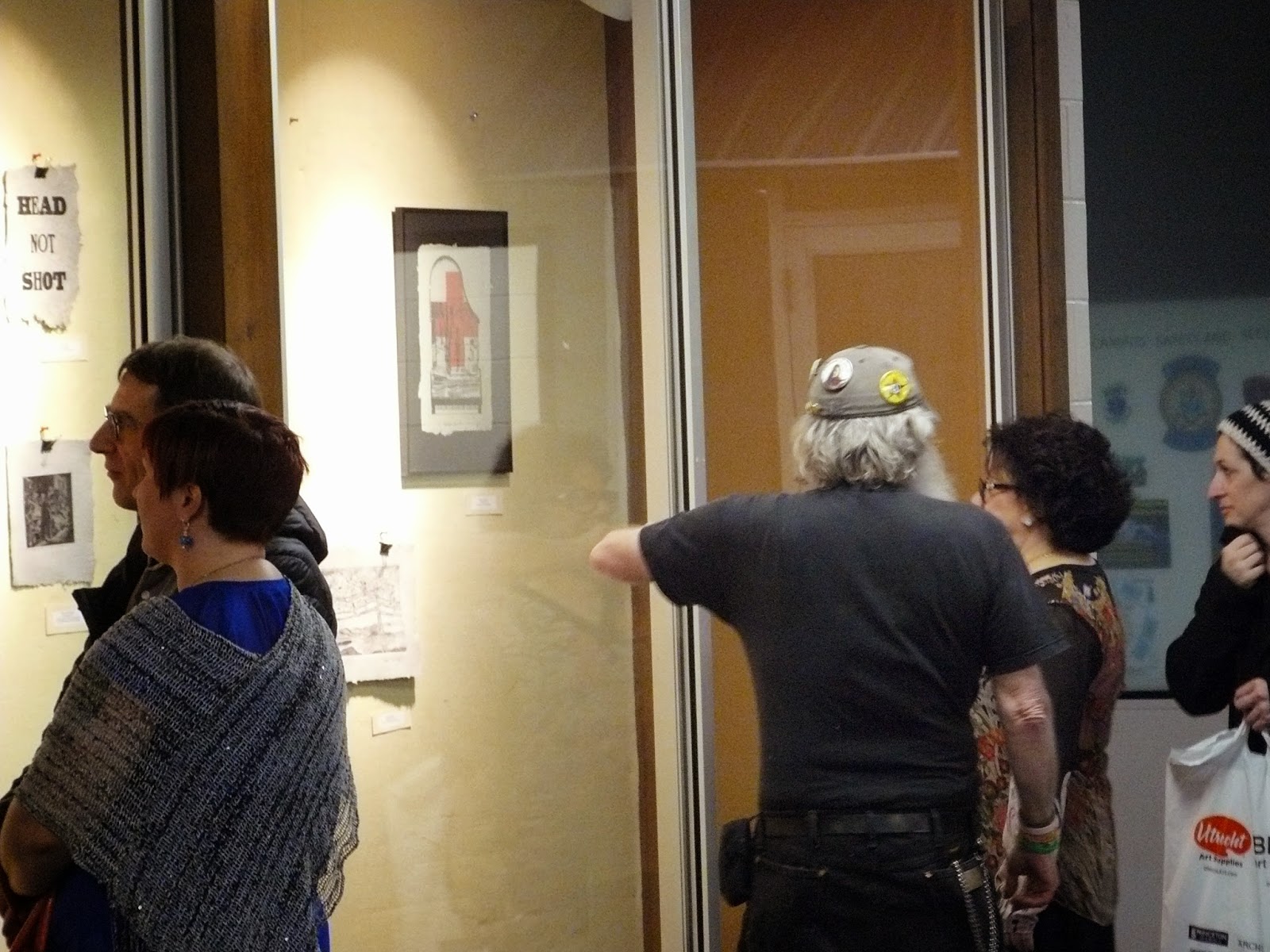
| Vet art at Gloucester CC (photos by Jan Barry) |
Despite anxiety, depression, post-traumatic stress disorder,
sleeplessness, night vision problems and other health woes, a group of military
vets trekked through Friday night traffic to cheerfully commemorate a public display of
their art.
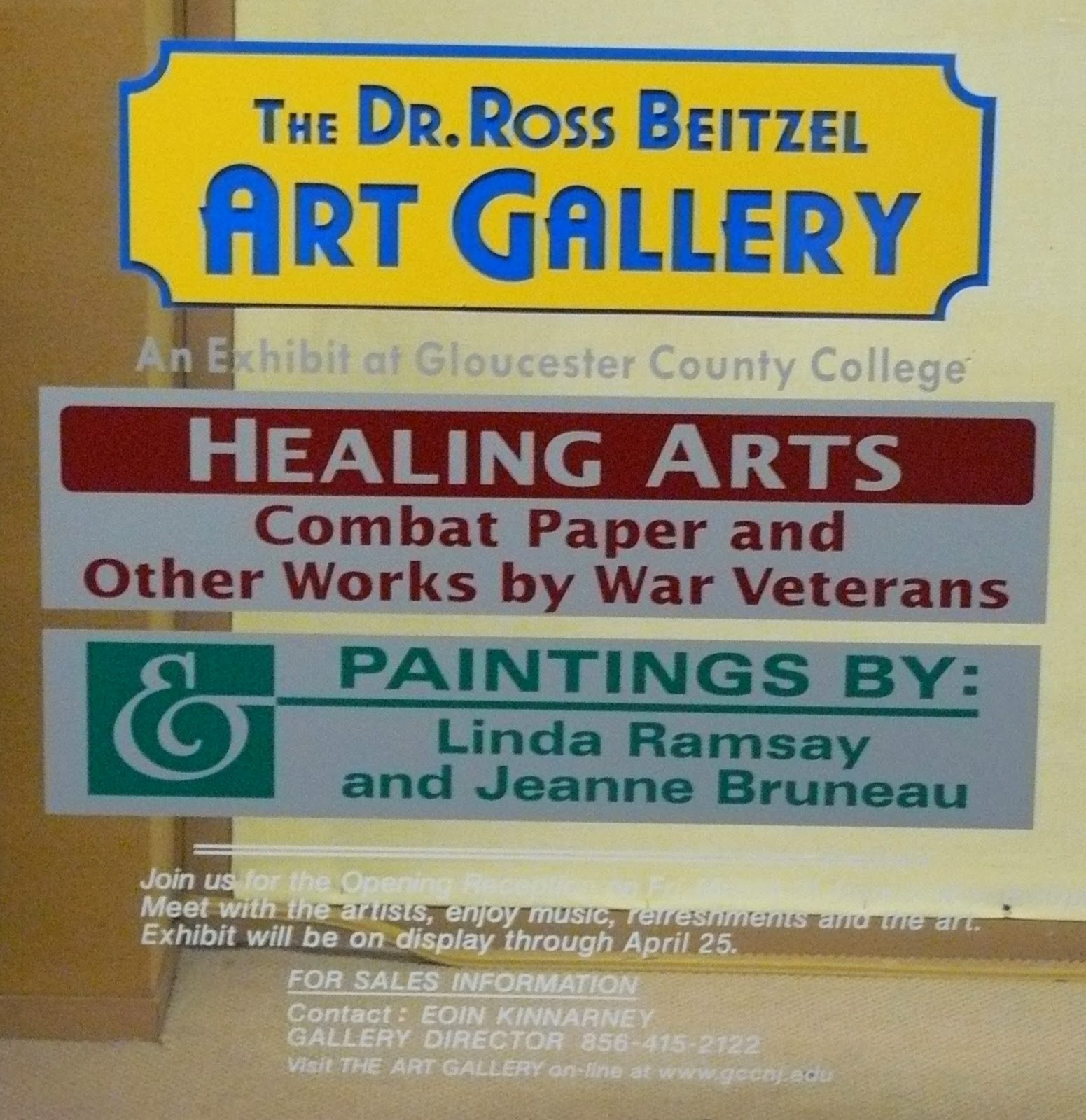
An array of paintings, drawings, etchings and other modes of
illustration is on display like a parade through the campus center at Gloucester County
College in Sewell, NJ.
The work was created over the past year in art workshops at the Secaucus (NJ) Vet Center and,
over a longer period of time, in Combat Paper workshops in New
Jersey and other parts of the US. Thirteen vets are represented
in the “Healing Arts: Combat Paper and Other Works by War Veterans” show, which
runs through April 25.
The vets include Michael Eckstein, Barry Jensen and Joseph
Lis, who all served in Vietnam
and are core members of the Secaucus
Vet Center
art group. Other vets with work in this show developed their art through Combat
Paper workshops—including Iraq
war vets Drew Cameron, David Keefe, Jennifer Pacanowski and Eli Wright, plus Somalia vet Sarah Mess and Vietnam era vet
Walter Zimmerman. Several others—Vietnam
vets Jim Fallon, Walt Nyard, Frank Wagner and myself—participated in and
learned from both workshop approaches.
As noted in the program book:
Transforming war uniforms into art in Combat Paper workshops, many military veterans in New Jersey and across the nation have traded the familiar grip of rifles for scissors, carving knifes, paint brushes and other healing implements of art. Meanwhile, veterans attending the “Paint Your Pain” Art Group at the Secaucus (NJ) Vet Center have been exploring a wide variety of media from water colors to pen and ink to oil paintings, to probe, uncover and convey hard-to-express experiences.The art workshop at the Secaucus Vet Center provides a gathering place for veterans to share art-making and post-combat survivor tips. “After many years of doing talk therapy with veterans, I realized that another more powerful outlet was needed,” said Angela Maio, who recently retired as a family therapist at the Vet Center, on creating the art workshop that has drawn veterans who served in Vietnam, Afghanistan and Iraq. “The ‘Paint Your Pain’ Art Group has had a healing cathartic effect on participants’ combat stressors. Several members have expressed the feeling of finally finding closure to their nightmares...”The Printmaking Center of New Jersey’s Program Combat Paper NJ is run by veterans, for veterans. It provides welcoming settings where veterans can explore art to help recover from physical, psychological and emotional effects of war. In workshops at college campuses, community centers, art studios, VA hospitals and military installations, Combat Paper brings the ancient arts of hand-papermaking and printmaking to veterans of all conflicts. “We deconstruct, reclaim and communicate,” David Keefe, an Iraq war veteran and director of Combat Paper NJ, says of turning old uniforms into paper used to display vets’ art works. “It’s the perfect marriage of concept and medium. It transforms the material, the artist and the viewer.”
Gallery Director Eoin Kinnarney, who hosted the opening
reception on Friday, said many students and staff members at the college
were entranced by the vets’ work. Co-host Diane Macris, administrator of the
Gloucester County Cultural Heritage Commission, commissioned the exhibition
after reading about the “War and Peace” art show and poetry reading that most
of these vets presented at the Brennan Courthouse Gallery in Jersey City last fall.
Wednesday, January 22, 2014
Winter Tracks
| "Winter Tracks" cover (photo/Jan Barry) |
Having grown up in the snow belt of upstate New York, winter is not my favorite season. Still, I enjoy sparkling vistas of snow and ice—as long as they’re not on my driveway, where my car slid out of control last night despite both feet on the brakes, careening in slow motion down the incline until a front tire skated into a snow-cushioned stone wall. That set off long-buried sensations of spinning around on an icy country road decades ago and slamming into a snow-filled ditch.
The cold snaps this winter revived memories in my bone marrow of trudging to school into a stiff wind in minus-zero-degree weather, back in the day when kids had to walk backwards through blizzards, to keep from freezing your face.
Yet, after the latest polar blast whiplashed the East Coast, the sun this morning sparkled on the post-storm snowy landscape. That’s the delightful part of this often miserable season, which I focused on in my latest photo book, titled Winter Tracks.
These photos were taken in recent years in New Jersey and upstate New York, while out and about after snow or ice storms, plus a memorable scene I encountered last summer of dazzling pockets of snow on a mountaintop in a national forest in Wyoming.
To view the photos in this collection, go to:
www.mypublisher.com/index/?e=OHm3Q8zJl3QKzEdJT2lWzPi6ySe-WSg9&showForm=true
Subscribe to:
Posts (Atom)