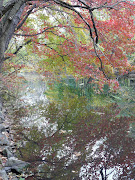
Osprey on nest near Cayuga Lake (photo by Jan Barry)
Meditation Blues
Sleepy Sunday morning,
During chair yoga slow stretch
My thoughts wander
Like wayward clouds
The other side of 80
Is a place I never expected to be—
Eying the fast lane
From a bedroom chair
Thursday, July 11, 2024
Wednesday, July 10, 2024
Hitchhiking Home from Danang Book Review
“McCarthy has led a very interesting life,” one senior wrote on ratemyprofessors.com. “He draws on his experiences in his writing and encourages his students to do the same. When I was his student he really pushed me to dig deeper and do something meaningful. He's passionate about poetry and creative writing.”
I got some insight into this dynamic while teaching journalism at the same college for several years. Gerald McCarthy also enlightened his students by bringing in as guest speakers avant-garde poets addressing war and social issues. Retired now as professor of English at St. Thomas Aquinas College, McCarthy has dug deep into his past to produce an astounding volume of literature. Hitchhiking Home from Danang: A Memoir of Vietnam, PTSD and Reclamation (McFarland, 2024) reveals the inner world of many war veterans that home folks haven’t a clue about.
“You come home alone and no one knows what it’s like…the aloneness would not let go of me, it clung like a mist or a shadow, and I couldn’t shake it,” he writes. “I felt like there was a stranger in the room, someone I hardly knew—and the stranger was me. Alone, aloof, apart. It stayed and grew and became my ‘thing’ and I could not shake it or find a way out of the despair and unrest it brought.”
There were things that happened in Vietnam that he couldn’t talk about. He couldn’t find words for what troubled him when he went AWOL from a Marine base in Norfolk, Virginia. He couldn’t blurt it out when he ended up in jail, in a military brig and in a Navy hospital psychiatric ward. He couldn’t say, years later, when his 18-year-old son asked what happened.
“I tell Nate, ‘Well, I just left, I’d had enough of it, you know.’ And I think that’s close to the truth, but I’m leaving things out on purpose,” he writes. “I’m leaving out the nightmares, the waking sweats…I’m not telling him about the flashbacks, about the dead, about the other stuff.”
There were no words for what to say about the war for 19-year-old combat vets coming home in 1967. Words like post-traumatic stress, survivor guilt did not yet exist. Grief was not in the lexicon of a Marine. Even years later, he couldn’t tell his wife about the damn, disturbing dreams that kept popping up.
“My wife shakes me in the dark and asks, ‘Who are you talking to? Why are you so restless?’” He couldn’t tell her that sometimes he was intently talking with dead buddies, that he was suddenly remembering a sergeant’s drunken screams about the horrendous casualties in the 1965 invasion of the Dominican Republic, the explosions of the mortar attack shortly after he got to his field unit, the mortar attack on the Danang airfield when he was about to leave for the States, the airplane burning, men scrambling out of the flames, and so many other ways Marines died in Vietnam.
“And then the others too, after I came home, after I was discharged, after all the ‘military madness’ had ebbed and I was drifting in a cloud of stelazine and beer and regret,” he wrote. “Bill Shaw crashing his old Corvette into a tree at night…Dennis Michaels…hung himself in his parents’ home…two months back from his time with the Army.”
McCarthy struggled through classes at a state college. He got into the Iowa Writers Workshop, where professors told him the war was over and to write about other things. He wrote poetry about the war to try to describe it. War Story: Vietnam War Poems (The Crossing Press, 1977) took a crack at it. It described the elements of PTSD before the malady was named by the psychiatric establishment. That first poetry collection caught the attention of Gloria Emerson, the fabled New York Times war correspondent, who became a mentor. She got him an assignment to write an article about the dedication of the new Vietnam Veterans Memorial in Washington, DC. “You have to go down there and cover the dedication ceremony and then you’ll write a poem about it later,” she told him in a telephone call. “First you get paid to write about it and that will cover your expenses.”
He reached out to other vets, joining Vietnam Veterans Against the War. He offered writing workshops for vets, taught writing at Attica prison, in migrant labor camps, county jails, schools. By the time he became a college professor, he knew a lot about how to help other people tell their stories.
But he struggled to tell his own. This book is focused on revealing, 50-some years since his return from war, what he found so hard to talk about. In retirement, he can no longer hide behind the sandbags he erected as a college professor who took on extra work, including teaching at the American Academy in Rome and at local schools.
“Now they come back when I’m alone, and in the dusk those shadows start to materialize. I can see them—glimpse their faces—this legion,” he writes. “And they are there waiting. They know I have had a life. And I have to join them at some point. I keep trying to tell a few stories, push away from what is there… I think the solution is to learn how to speak to people again, to try to communicate, to keep forcing yourself to wake up. You can’t give in to the ghosts, to the grief, to the overwhelming sadness.”
And he discovered another insight. “Now 50+ years later, and after four years of therapy at the James A. Peters VA Hospital in Bronx, New York, I have come to realize that the tranquilizers were a stumbling block to my recovery,” he writes. “Now I know I needed therapy and counseling. Now I know the tranquilizer led to other depressants like alcohol…and drugs, to feeling depressed and full of self-loathing.”
As a persistently creative poet and writer, Gerald McCarthy demonstrates in this book how he helped forge a better way of dealing with PTSD and survivor guilt: write it out.
Update
Summer flowers (photo by Jan Barry)
Summer Song
I escape the crowds and summer heat,
hanging out in our backyard botanical garden—
ringed by a long overgrown privet hedgerow
entangled with grape vines on one side,
an old apple tree and towering elm
sheltering butterfly bushes and
a rainbow array of flowers in the back,
plus a meditation garden behind the garage
that’s nestled amid butterfly bushes,
a sprawling hemlock with multiple tops,
and a conclave of rock walls—
here I can sit and commune with
butterflies, humming birds,
song birds flitting from bird feeders
to bird bath to hidden nests
Summer Song
I escape the crowds and summer heat,
hanging out in our backyard botanical garden—
ringed by a long overgrown privet hedgerow
entangled with grape vines on one side,
an old apple tree and towering elm
sheltering butterfly bushes and
a rainbow array of flowers in the back,
plus a meditation garden behind the garage
that’s nestled amid butterfly bushes,
a sprawling hemlock with multiple tops,
and a conclave of rock walls—
here I can sit and commune with
butterflies, humming birds,
song birds flitting from bird feeders
to bird bath to hidden nests
Monday, May 3, 2021
What's Up
"Sneakers" (Jan Barry photo)
Stumbling Around
Three small strokes
Rearranged my brain—
Trying to see what still works
Wobbly balance exercise
Revives muscle memory of toes
In cross-country skiing
First base catch move
Restores arthritic right hand
When an errant ball appears
A month of hard core PT
Turns shuffling waddle
Into senior citizen steps
--Jan Barry
Sunday, March 14, 2021
Covid Year
Mask with Birds (Jan Barry photo)
By Jan Barry
A year of hair
Unfurls down my neck—
I’ve outlived a pandemic
So far
Millions dead and dying
As preening politicians bicker—
What’s there to celebrate
In this covid time
Lost my job, my livelihood,
Quarantined from friends
And family gatherings,
Hunkering from death’s breath
Only the lucky
Are still living—
Living like moths
Flitting amid the flames
This is what depression
Looks like, as year 2 looms—
I’d rather soar with eagles
And migrate with the seasons
Tuesday, February 23, 2021
Morning on the Hackensack River
Bald Eagle Eating Fish at Secluded Stretch of Hackensack River (Jan Barry/photo)
By Jan Barry
A confluence of eagles
at a narrow bend in the river
lined with gnarled old branches
leaning over the water
flowing between snow-crusted
stretches of woods—
the silence broken by commuter
trains, truck engines, Canada
geese, mergansers foraging for fish
By Jan Barry
A confluence of eagles
at a narrow bend in the river
lined with gnarled old branches
leaning over the water
flowing between snow-crusted
stretches of woods—
the silence broken by commuter
trains, truck engines, Canada
geese, mergansers foraging for fish
Saturday, February 20, 2021
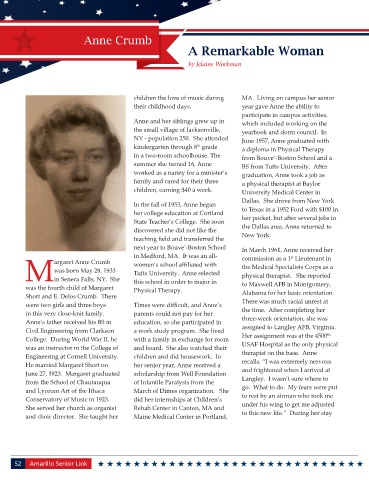
Anne Crumb, RIP
My aunt, Margaret Anne Crumb, died recently in Amarillo, Texas. She was 85 and in ailing health but had a much younger, spritely spirit. For years I stopped by to visit during cross country road trips, trading travel tales and other yarns. She’d seen much of the world in an Air Force career, retiring as a lieutenant colonel. Among other things, she drove long haul, semi-tractor trucks during a colorful life after moving to Texas.
My first vivid memories of Aunt Annie have to do with “slow poke passing” in our 1950s cars on a country road when I was a teenager. About that time, she joined the Air Force as a physical therapist. About a year later, I joined the Army and visited her on a weekend pass at her bayside place outside Langley Air Force Base in Virginia. Then I went to Vietnam and she went to Libya. Our lives went in different directions. But we stayed in touch over the years.
Home base was the Taughannock Falls area of New York’s Finger Lakes, where we occasionally met up at family gatherings. One summer Anne announced that she preferred living in Texas. When I swung by her place in Amarillo on a drive to California after I retired from newspaper work, I learned why. She liked the wild flowers, the wind-swept vistas, the wide open skies of the high plains. She had friends who’d turned an empty shopping center into an artists’ colony. She loved rambling out of town to the jaw dropping splendor of Palo Duro Canyon.
About a decade ago, she moved into a senior living complex, as various ailments cramped her hands and walking became progressively hazardous. She gave her kayak to younger relatives. She enjoyed entertaining visitors, venturing out to a favorite Mexican restaurant next door. Checking in on her during the Covid crisis last summer, I found she’d moved to a state veterans’ home.
Amarillo Senior Link magazine in 2019 profiled her in a special issue honoring military veterans. My favorite anecdote in this account tells how after graduating from college in 1957, “Anne took a job as a physical therapist at Baylor University Medical Center in Dallas. She drove from New York in a 1952 Ford with $100 in her pocket.”
My first vivid memories of Aunt Annie have to do with “slow poke passing” in our 1950s cars on a country road when I was a teenager. About that time, she joined the Air Force as a physical therapist. About a year later, I joined the Army and visited her on a weekend pass at her bayside place outside Langley Air Force Base in Virginia. Then I went to Vietnam and she went to Libya. Our lives went in different directions. But we stayed in touch over the years.
Home base was the Taughannock Falls area of New York’s Finger Lakes, where we occasionally met up at family gatherings. One summer Anne announced that she preferred living in Texas. When I swung by her place in Amarillo on a drive to California after I retired from newspaper work, I learned why. She liked the wild flowers, the wind-swept vistas, the wide open skies of the high plains. She had friends who’d turned an empty shopping center into an artists’ colony. She loved rambling out of town to the jaw dropping splendor of Palo Duro Canyon.
About a decade ago, she moved into a senior living complex, as various ailments cramped her hands and walking became progressively hazardous. She gave her kayak to younger relatives. She enjoyed entertaining visitors, venturing out to a favorite Mexican restaurant next door. Checking in on her during the Covid crisis last summer, I found she’d moved to a state veterans’ home.
Amarillo Senior Link magazine in 2019 profiled her in a special issue honoring military veterans. My favorite anecdote in this account tells how after graduating from college in 1957, “Anne took a job as a physical therapist at Baylor University Medical Center in Dallas. She drove from New York in a 1952 Ford with $100 in her pocket.”
Subscribe to:
Posts (Atom)