Sunday, October 9, 2011

Protest at Wall Street

Ken Dalton (center) holds VFP banner at Wall St. protest

A contingent of Veterans For Peace and Military Families Speak Out members from New Jersey joined the Occupy Wall Street demonstration in New York City on Saturday, October 8.

Many in the crowd of young people, older folks who dusted off memories of the protests of the '60s and '70s, and photo-snapping tourists seemed delighted to see the VFP banner unfurled near a corner of Liberty Plaza facing the new office towers being constructed at the site of the former World Trade Center. Among the Jersey contingent was VFP Chapter 21 President Ken Dalton, a Navy vet of the Vietnam war, who worked as a fire fighter in search and rescue operations at Ground Zero in the wake of the Sept. 11, 2001 attack.

A common question of vets by news reporters who stopped by for a comment was “What do war and Wall Street have in common?” Duh. Millions of unemployed veterans and other folks caught in the web of trillion-dollar wars and an economic collapse that the federal bailout of Wall Street banks was supposed to fix could have told them in a New York minute.

Many of the demonstrators in New York on Saturday eloquently stated the reasons for their dismay in an array of hand-made signs, some of which are shown here.

(Photos by Jan Barry)


Thursday, October 6, 2011

Saving Grace

Lake at Arrow Park, NY

Saving a corner of the Earth in its natural state is increasingly hard work. It takes many hands and, often, many organizations. So it was that, the other day, an eclectic crowd of people gathered beside a forest-fringed lake about 38 miles northwest of New York City, to celebrate the latest conservation success story.

For reasons related to recent and legendary events in American history, survivors of the New York City Fire Department’s staggering losses at the World Trade Center on Sept. 11, 2001, stood besides Native Americans who brought a 20-foot-tall healing totem pole that was carved in Washington State. Leaders of the New York-New Jersey Trail Conference in nearby Mahwah, NJ, stood with current and former New York state conservation officials, local municipal officials and private landowners in this remote corner of the Hudson Highlands in Monroe, NY.    

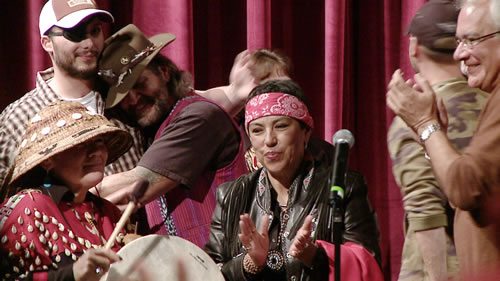
To the beat of a Native American drum, the gathering of about 100 people celebrated the conservation buyout of nearly 260 acres purchased from the privately-owned Arrow Park, to be added to adjacent Sterling Forest State Park, which is part of the Palisades Interstate Park system. The conservation deal was brokered by the Orange County Land Trust with $5.3 million from the State of New York Office of Parks, Recreation and Historic Preservation.

“These projects would never happen without so many people,” said Paul Dolan, executive director of ABC News International and a conservation advocate for the NY-NJ Trail Conference, as a big swath of the audience was called forward to be lauded for their assistance. Dolan and his wife JoAnn, a former executive director of the hiking trails group, previously helped lead a bi-state campaign that preserved some 20,000 acres of open space that became Sterling Forest State Park. Developers had targeted the area with plans to build a sprawling city of housing and industry in the mountain forests that form the headwaters of northern New Jersey’s water supply.

Arrow Park was created in 1948 as a country retreat for a group of Russian, Ukrainian and Polish families living in New York City. Such large tracts of land in the region have increasingly been sold off or subdivided for housing developments.

The gathering at Arrow Park also celebrated the visit of a troupe of American Indians who’d previously  traveled across the country in 2002 to erect a healing totem pole besides the lake in the heart of the park to commemorate the victims of the 9/11 attacks. Now they were passing through with a new healing totem headed for the National Library of Medicine in Bethesda, Maryland.

“I was thinking back to nine years ago when we came to this very spot,” said Fred Lane, a filmmaker with the Lummi Indian Nation, which provided both healing totems. “We have to remember our ancestors, our elders. I remember something my father said, ‘What are you going to do to be remembered by?’”

Master carver Jewell James played a song on a wooden flute. “No matter who we are racially or religiously, we are all human beings,” he said. In 2002, James was profiled in a USA Today article on the making of the healing totem for 9/11 victims. He recalled how his tribe had helped him deal with grief when two of his children were killed in traffic accidents. So he decided to help others by carving healing totems. "You never know how much it might help," he said. "This is my gift."

The Orange County Land Trust’s website provides a poignant perspective on what happened in the wake of that gift that the Pacific Coast tribe brought east to Arrow Park. “Recently, the Fire Department of New York’s Counseling Service Unit presented the Orange County Land Trust with an award for leading this successful 10-year campaign to protect Arrow’s land which includes an 80 acre FDNY memorial planting tract. Since 2002, the families of firefighters who lost their lives in the line of duty on 9/11 gather at Arrow Park for a tree planting ceremony and day of remembrance.”

In his remarks at last week’s ceremony, Paul Dolan said “Our goal is that this be a place for all different groups to heal.” 

The Orange County Land Trust website explains the genesis of that goal:  “A remaining parcel of 75 plus acres [which includes a rustic complex of buildings] is under active study as a center for programs for children and families by a consortium of non profit sponsors. Currently Calvary Hospital runs a summer camp on this land for children who have experienced the death of a family member. This bereavement program has served over 400 children since it was started 11 years ago.

“Arrow has been the site of recent professional training programs for Orange County organizations working with veterans and their families. Prior programs and events have focused on children of war from Sierra Leone and recreational programs for children with special needs.”

For more information:

Friday, September 16, 2011

Republican Peace Piper

Rep. Ron Paul
Ron Paul is the kind of presidential candidate the American people haven’t seen in a long time—one who’s dead serious about ending overseas military adventures. That’s a stance that is increasingly popular with disgruntled voters across the political spectrum, which could well spell trouble for President Obama. Activists on the left and the right are increasingly fed up with Obama’s military surge in Afghanistan and foot-dragging in getting the remaining troops home from Iraq.

At the Republican presidential candidates’ debate sponsored by CNN and the Tea Party Express in Tampa, Florida the other night, Paul drew a thunder roll of applause when he said: “We spend $1.5 trillion overseas in wars we don’t need to be in and we need to cut there. And then put this money back into our economy here.”

This kind of response is rattling the foreign policy establishment. With polls now showing that a majority of Republicans as well as Democrats and Independents want a drawdown of US forces from Afghanistan, one startled foreign policy analyst noted, “in the mid-August Republican presidential candidates’ debate in Ames, Iowa, one of the loudest applause lines was for isolationist Rep. Ron Paul’s demand to ‘bring our troops home.’”

Paul, the controversial, libertarian congressman from Texas, who served in the Air Force during the Vietnam war, doesn’t just toss out applause lines. Like Eisenhower, who ended the war in Korea and spent his presidency reining in a rambunctious stable of warhorses, Paul is determined to spell out the fiscal and social consequences of allowing the military-industrial complex to rule the roost.

“We’re under great threat,” Paul continued during the Tampa debate, “because we occupy so many countries. We’re in 130 countries. We have 900 bases around the world. We’re going broke.”

He continued to press his point even when many in the audience began booing his contention that US military actions overseas stirred up a hornet’s nest of terrorist reactions. “We have to be honest with ourselves. What would we do if another country, say, China, did to us what we do to all those countries over there?” Paul said.

It’s hardly news that Ron Paul has been saying these kinds of things for years. “Opposition to the wars in Iraq and Afghanistan, and more generally to U.S. military activity abroad, has been a cornerstone of Paul’s candidacy and sets him apart from the rest of the Republican field,” ABC News noted in a report on its website.

What’s changed is the sharp rise in public unease over the decade-long war the US launched in response to the attacks on the World Trade Center and the Pentagon by 19 young men from the Middle East on behalf of grievances that are still being hotly disputed.

“Two in three Americans, 65 percent, now want to reduce or withdraw U.S. troops from Afghanistan, up dramatically from 39 percent in 2009, according to the new German Marshall Fund 2011 Transatlantic Trends survey,” noted a blog piece by Bruce Stokes that CNN reposted from YaleGlobal Online.

“A solid majority, 58 percent of Republicans, now want to see U.S. forces in Afghanistan reduced or withdrawn. Such sentiment is up a dramatic 36 percentage points since 2009, according to the GMF survey,” Stokes continued. “Disengagement is even more strongly supported by Democrats (70 percent) and Independents (66 percent), but their swing to that position is less pronounced. Backing for reduction or withdrawal is up 23 points among Independents and 24 points among Democrats since 2009.”

Ron Paul’s stance on military spending, or more likely the tanking poll numbers on public support for the Afghan war, stirred a Greek chorus of war weariness from two other Republican presidential candidates, former Utah Governor Jon Huntsman and Texas Governor Rick Perry. Here’s an amen moment in the Republican candidates’ otherwise contentious debate that the liberal Nation magazine ran approvingly on its website: 

Huntsman: We are ten years into this war.… America has given its all in Afghanistan. We have families who have given the ultimate sacrifice. And it’s to them that we offer our heartfelt salute and a deep sense of gratitude. But the time has come for us to get out of Afghanistan. We don’t need 100,000 troops in Afghanistan nation-building at a time when this nation needs to be built. We are of no value to the rest of the world if our core is crumbling, which it is in this country.

Perry: Well, I agree with Governor Huntsman when we talk about it’s time to bring our young men and women home and as soon and obviously as safely as we can. But it’s also really important for us to continue to have a presence there. And I think the entire conversation about, how do we deliver our aid to those countries, and is it best spent with 100,000 military who have the target on their back in Afghanistan, I don’t think so at this particular point in time. I think the best way for us to be able to impact that country is to make a transition to where that country’s military is going to be taking care of their people, bring our young men and women home.

Chances are that Obama, who successfully ran in 2008 on a platform of reforming the federal government, will face a Republican challenger next year pressing for real change in the war arena.

For more information:

Sunday, September 11, 2011

Peace Beat


 War drums began beating across America before the dust settled at the World Trade Center and the Pentagon. It’s an all-American tradition to march to the beat for military action, the fountain of flag waving excitement that produces legions of war correspondents, bugle-blaring headlines and armchair commandos in newsrooms.   

It is rare to hear that a drum-beat journalist felt, in retrospect, that rushing to war was perhaps a grave mistake. It’s almost historic, in fact, to see the reconsideration that Bill Keller, a top editor and columnist at the New York Times, published amid the flood of 9/11 commemorations on the 10th anniversary of that explosive spark of war the US expanded to places most Americans had barely heard of before.

“The world is well rid of Saddam Hussein. But knowing as we now do the exaggeration of Hussein’s threat, the cost in Iraqi and American lives and the fact that none of this great splurge has bought us confidence in Iraq’s future or advanced the cause of freedom elsewhere— I think Operation Iraqi Freedom was a monumental blunder,” Keller wrote in a New York Times Magazine article revealing his conversion from the war hawk club of liberals beating the drums for military invasions of Afghanistan and Iraq.

Aside from this astonishing note of atonement, the bulk of the Times’ massive retrospective in the Sunday newspaper is essentially a monument to the US news media’s cheerleading for a decade of military blunders.

A major reason for this is that, for all the war correspondents and warrior-editors, there are few if any journalists assigned to cover waging peace.

Do editors at the Times and other mainstream news organizations ever travel outside military-oriented circles and see what groups such as September 11th Families for Peaceful Tomorrows, Peace Action, Veterans For Peace or the US Institute of Peace are doing? Even small newspapers have a military affairs reporter. Does any news organization in America have a peace beat?

The glaring lack of coverage of peace groups’ actions spurred a special report earlier this year by the Nieman Watchdog website of the Nieman Foundation for Journalism at Harvard University.

“Antiwar activists repeatedly stage dramatic acts of civil disobedience in the United States but are almost entirely ignored by mainstream print and broadcast news organizations. During the Vietnam era, press coverage of the fighting and opposition to it at home helped turn public opinion against the war. This time around lack of homefront coverage may be helping keep military involvement continue on and on,” wrote John Hanrahan, a former Washington Post reporter.

“By ignoring antiwar protests almost totally, editors are treating opposition to the ongoing war in Afghanistan much as they handled the run-up to the war in Iraq: They are missing an important story and contributing to the perception that there is no visible opposition to the U.S. wars and ever-growing military budgets, even as polls show overwhelming support for early U.S. military withdrawal,” Hanrahan continued.

Among the examples of non-coverage of significant events that Hanrahan cites is this:

“Last December 16, in a demonstration organized by Veterans for Peace, 500 or more people gathered outside the White House, as snow was falling, to protest the war and to support Wikileaks and accused leaker PFC Bradley Manning. As Nieman Watchdog reported in a previous piece in this series, there were 131 arrests – including a sizable number of veterans of current and past wars – for nonviolent acts of civil disobedience. (This was the most arrests at the White House at any point in 2010.) One of the arrestees had chained himself to the White House fence and another to a lamppost. Additional newsworthy factors: Among those arrested were the nation’s most famous whistleblower (Daniel Ellsberg); a Pulitzer Prize-winning reporter (Chris Hedges, the former long-time war correspondent for The New York Times); a much-praised FBI whistleblower (Coleen Rowley); a former CIA analyst who used to prepare daily presidential briefings (Ray McGovern), among others. Additionally, the demonstration seemed newsworthy because it coincided with both the release of the Pentagon’s latest progress report on Afghanistan to President Obama and the results of a new ABC/Washington Post poll in which 60 percent of Americans responded that the Afghanistan war had not been ‘worth fighting.’

“The event was covered by The Huffington Post, the Socialist Worker, OpEd News, Salem-News.com in Oregon, and the Sydney (Australia) Morning Herald, but was ignored by The Washington Post, The New York Times and almost all other mainstream media,” Hanrahan found.
Veterans For Peace protest at White House

 As the Nieman report notes, there’s been a colossal failure of balance in coverage of what’s going on in the world. It’s a cultural failure, as well.       

“It’s been a decade since 9/11, time enough to let go and shift the way we approach our decisions about war, right?  One might think so, but … I’m beginning to question if and when we will choose to let go and imagine a new way forward,” notes James A. Moad II, an Air Force officer whose career as an airline pilot was diverted to military missions by the long war. 

“Like most Americans of drinking age, that September day is seared into my subconscious,” he continued. “As a young commercial pilot back then, I can still remember my own nightmares as I imagined what took place in those cockpits, thinking about an old pilot buddy who’d been murdered there, and more than anything, the feeling of insecurity reverberating out from the rubble of those two towers like great clouds obscuring the future and limiting us, blotting out the imagination necessary to see beyond the anger and destruction.”

Moad’s incisive comments were not conveyed in the New York Times’ galaxy of 9/11 reminiscences, but in a War, Literature & The Arts Blog that he administers.

The internet and community-oriented newspapers provide a vital forum for many voices with a different perspective than the usual sources featured in the national news media.

"One of the outcomes of 9/11 is we need to make the decision about what kind of society we want to be," Andrea Leblanc, whose husband Robert died on United Flight 175 when it smashed into the South Tower of the World Trade Center, told a local newspaper in New Hampshire, Foster’s Daily Democrat. "What do we want to teach our kids? The story isn't about the fact that for 10 years I've been a widow. It's about the real cost of 9/11. I think this country squandered its moral authority. To me, it's all about peace; what societies are doing to either move toward or away from conflict."  

Leblanc credited fellow 9/11 survivors with providing a compassionate, activist community of support for her anguish.

“An eye opening thing for Andrea through her involvement with September Eleventh Families for Peaceful Tomorrows is the people all over the world who are reaching across borders to converse and share with other cultures,” Foster’s reporter Jennifer Keefe wrote. “She noted the numerous women's networks in Afghanistan and youth networks that reach out via Skype to hold conferences with other youths to talk about love and understanding. The groups and organizations dedicated to forming unity and speaking out in the wake of 9/11 are not in short supply, and demonstrate each day there is a compassion across borders that breaches even the deadliest of wars.”

It’s not hard to find these stories. In Philadelphia, PA, CNN filmed a Saturday night crowd at World CafĂ© Live drawn to an evening celebrating peace and ice cream. “Philadelphia-based Christian author and activist Shane Claiborne partnered with Ben Cohen, co-founder of Ben and Jerry’s Ice Cream, to raise public awareness about federal military spending,” noted CNN’s website report.

“The evening started off on a somber note with Cohen pouring 10,000 BB gun pellets into a metal container to illustrate the power of the United States’ nuclear arsenal in front of a stunned audience. ‘It’s that kind of overkill mentality that drives an out-of-control Pentagon budget,’ he said.” Another part of his demonstration is a tall stack of oreo cookies looming over tiny piles of cookies representing the military vs. everything else in the federal budget’s priorities.

Winding up the evening, Cohen said: “If we’re going to have fewer bombs and more ice cream, we need to shift our budget to what helps people live instead of killing people.”    

The ice cream business maven has traveled the nation and partnered with community activists, business executives, war veterans and many others to present a stunning critique of military spending overseas while the home front economy crumbled. I first saw his BB and cookie demonstration at a journalists’ conference in Vermont five years ago. Video versions from presentations around the country are all over YouTube.    

For more information:

Jan Barry is an award-winning investigative journalist. He has been a peace advocate since resigning from the US Military Academy after serving an Army tour in Vietnam.

Monday, August 22, 2011

Vietnam: Another Kind of Adventure

Ken and Bill at old battleground in Vietnam 
W.D. Ehrhart has been turning the tragedy of the Vietnam war inside-out, upside-down and sideways in a whirlwind of memoirs, articles, poems, poetry anthologies and travel pieces since surviving the battle of Hue in 1968—and living to ponder what the hell all the death, destruction and desperate encounters in Indochina added up to.

His latest literary foray is an online journal—titled “Ken and Bill’s Excellent Adventure”—of a journey to Vietnam this summer with a Marine buddy who was also wounded by the rocket explosion that shredded their shelter in a bedroom-turned-battle station. The story of this trip back in time is artfully laid out on a magazine-style website designed by Bill Ehrhart’s wife Anne, who took many of the photos accompanying the text.

As in most Ehrhart stories, there’s an unexpected twist. Ken is the nickname for Kazunori Takenaga, a Japanese citizen who ended up in the US Marines in Vietnam. And so Bill makes a side trip to Japan to visit Ken’s homeland. And then the two aging war buddies, accompanied by Anne and photographer Sachiko Akama, travel to Vietnam to re-experience old battlegrounds. Along the way, they also encounter memorable sights and historic sites in two Asian nations—Japan and Vietnam—that have created vibrant peaceful societies in the wake of wars with America.

“As we approached Hue, we crossed the bridge over the An Cuu Canal, just as Ken and I had done on the morning of January 31st, 1968, but the war was nowhere to be seen and there were no ghosts awaiting us, just a vibrant, throbbing city that was almost unrecognizable except for major landmarks like the Truong Tien Bridge spanning Song Huong—the River of Perfumes—Hue University, and of course the famous Citadel,” Ehrhart noted in a suddenly inward shift from describing Vietnam’s current scenery.

“Ken and I and a handful of other Marines had crossed Truong Tien Bridge during that first day of fighting, though we couldn’t have told you its name,” he continued. “We had tried to reach the Citadel, but had taken terrible casualties at the hands of hundreds of well-entrenched North Vietnamese firing down at us from windows and walls, and we’d had to fall back to the south side of the river, where most of the fighting took place during the first few weeks of the battle.”

“On another day,” he writes, “we drove from Hue to the old Demilitarized Zone marked by the Song Ben Hai.  We walked—stoop-shouldered most of the way—through the tunnels of Vinh Moc just north of the DMZ, where an entire village of 70 families lived underground for six years to escape U.S. bombardment.

“We walked across the river, from north to south, on the Hien Luong Bridge, destroyed by U.S. bombing in 1967, but rebuilt post-war for pedestrian traffic.  Several miles to the west of the bridge is Con Thien (‘the place of angels’ in Vietnamese), where Ken and I had spent a month living in a mud-infested, barbed wire-encircled collection of sandbagged bunkers, besieged by North Vietnamese artillery from the north side of the DMZ, but we could not go there because the area, still sewn with American mines, is too dangerous.”

Ken and Bill grin like they won the lottery as they pose for a photo together in the middle of the long-fought over bridge "straddling the 17th parallel at the old DMZ." During the war, Marines couldn’t have imagined walking across that bridge and surviving. Tens of thousands of American soldiers and millions of Vietnamese soldiers and civilians died in the battles over that geographic division.

The highlight of the trip is finding the house where the war nearly ended their lives. Better to let Ehrhart tell what it meant in the way that has made his memoirs and other writings on the war widely read around the world.

“The house, which in 1968 had had a brick wall around it, has since been entirely refurbished,” Ehrhart noted. “Looking fresh, crisp, and bright, it appears to be no older than the six-story four-star hotel built in two sections behind it, the two wings of the hotel forming an L into which the house nestles.  The grass lawn has been replaced by a tiled driveway and parking area with a motorscooter rental operation and an outdoor coffee shop.

“The house itself is now the business and administrative offices for the hotel, the Duy Tan (named for yet another emperor).  A young woman inside who spoke English told us that the hotel had been built in 2004, but the house dated to 1920.  That was the clincher.  This was the place.  We were so amazed to be here, alive and happy and 62 years old (well, Ken is 63), that we did not have the presence of mind to ask if we could go up to the very room itself.  No matter.  This was close enough.

“That evening, Anne, Ken, and I, accompanied by Sachiko Akama, the photographer who traveled with us, went for an evening cruise on the River of Perfumes.  On board with us were eight Vietnamese singers and musicians in traditional garb who performed traditional Vietnamese folk music for us.

“When they were finished, they gave us each two paper bags with candles inside.  The tradition is to light the candles, make a wish, and set the bags afloat on the river.

“I cannot begin to tell you how magical that evening was, how profoundly satisfying, especially for two ex-Marines who had nearly died only blocks from that river so many years ago.

“Later, standing on a balcony of the Mercure Hue Gerbera Hotel, Ken and I looked out over the city and the river bisecting it.  We could see the huge red and yellow Vietnamese national flag flying above the Citadel, illuminated by floodlights, the university that had been used as a refugee center during the battle, the park that had been our helicopter landing zone, the roofs of what had been the MACV compound (Military Assistance Command, Vietnam), even a corner of that building we’d been in when we’d been wounded, now dwarfed by the hotel built around it.  But the streets were crowded with noisy, jostling, energetic people on foot, on bicycles, in cars, in buses, and of course on scooters, scooters, and more scooters.  Vendors hawked postcards and fresh bread and river tours.  The river flowed with colorful tour boats.

“The bridge, with an unbroken stream of motorscooters going in both directions, blazed yellow to green to blue to purple to red and back to yellow.  The Huda beer sign cast a neon ribbon across the water.

“We did not speak.  There was nothing to say.  This is what we had come to see. A country.  Not a war.”

For more information:
http://wdehrhart.com/kbea-pages/introduction.html

Wednesday, August 10, 2011

Welcome Home

Eli Painted Crow and fellow vets in "The Welcome"


Bob and Moe Eaton’s marriage, shadowed for more than 30 years by nightmares from the war in Vietnam, was about to implode. Ken Kraft, an Army officer who proudly served in Iraq, felt betrayed by his son’s refusal to carry on the family tradition of military service. Eli Painted Crow, a former Army drill sergeant, felt betrayed by the nation that sent her to war on dark-skinned, tribal people like herself.

These were just some of the rubbed-raw emotions that a couple dozen war veterans and several family members brought to an unusual retreat in Oregon. In this deceptively quiet setting, a film crew recorded real life dramas brimming with outbursts of bitterness and laughter, tears and hugs, dark humor and dawning revelations. The focus of the four-day gathering, just before Memorial Day 2008, was to sort out what they wanted to say—in a poem or a song or a concise statement—to a crowd of people preparing a public event to welcome these warriors home from war.

“I’m asking you to f------ listen!” Eli Painted Crow shouted at the other participants in a particularly tense point in the new documentary called “The Welcome.” A retired Army sergeant and Native American peace activist, Painted Crow was fed up with interruptions as she attempted to explain how she felt about her deployment in Iraq, where fellow soldiers called combat areas Indian country. “I just want to be heard with your hearts,” she added, before stomping out the door to cool off. “If you don’t hear me with your hearts, I can’t heal.”

In another scene, a member of Veterans For Peace said he felt like the enemy in Vietnam. Another Vietnam vet retorted that he wasn’t the enemy but killed people who were the enemy. That set off a whirlwind of war justifications by other veterans.

Such scenes pull viewers intimately into the inner turmoil of the aftermath of war that swirls through many veterans across America. Throughout the 93-minute film directed by Kim Shelton, veterans and family members openly struggle to tame the turmoil long enough to find some pathway to healing.

“Sometimes you stumble into something out of a sense of duty or good intentions only to find yourself absorbed and overwhelmed beyond anything you might have anticipated,” a reviewer for The Oregonian, Shawn Levy, wrote of this low-budget film that was an audience hit at the Ashland (Oregon) Independent Film Festival this spring.

“From virtually the outset, with a poem by Laura Carpenter, a veteran of Afghanistan about to deploy to Iraq, ‘The Welcome’ drills directly through any emotional reserves you might bring into it,” Levy added. “You're unsteadied, startled, galvanized, and brought to sobs again and again.  There are dark jokes and harrowing accounts of the hellish confusion of war and its grip on the memory.  There are angry outbursts as the various veterans try to establish terms of respect and conduct with one another.  There are wry laughs and monumental silences.  And there are staggering moments of courage in which the veterans look as if they're merely speaking aloud but in which they are actually performing open-heart surgery on themselves -- in front of an audience and a movie camera.”

Amazingly, the participants ignored the camera as they candidly interacted with each other and with retreat leader Michael Meade, described by the filmmakers as a “mythologist and story teller who specialized in working with traumatized communities.” Meade’s ritualistic mixture of Native American chants and Irish stories grated on Eli Painted Crow and another Native American woman veteran. But after an outburst about respecting traditions, they participated on their terms.

“One of the ways to heal is to find out what our gifts are and begin practicing giving them,” Meade said, in guiding the group to write poetry, which he defined as “the speech of the soul,” in preparation for a Memorial Day event at the Oregon Shakespeare Festival in Ashland.

Retired Army Captain Ken Kraft wrestled with how to make sense of a phone call he’d gotten in Iraq that his son had deserted from Army ranger training and denounced the war. He felt betrayed, he said, and bolted from the podium back to his seat. At the Memorial Day event, Kraft praised the intense interaction at the retreat and read a poem about his pride in being a soldier and noted that he was trying to reach out to his son.

A young woman veteran shyly read a poem about the shame of a sexual assault by a military superior. Another young woman vet read a poem about older veterans reaching out and clearing a path for them.

Cynthia Lefever, whose son was severely wounded in Iraq, read a poem about a dream in which rows of wounded soldiers marched down a road toward her, beseeching: “Be our mom—for God’s sake, bring us home!”

“I found a voice I didn’t know I had,” Mandy Martin, another of the retreat participants, said in a recent PBS television interview. "The impact has been pretty immense," she said of the veterans' healing project. A follow up on the film website notes that she now works at the Department of Veterans Affairs as a congressional communications officer.

Moe Eaton, whose husband Bob served in Vietnam, read a poem about his frightening mood swings and suicidal statements. “Me: Why can’t you count your blessings? He: I don’t know.”

Bob Eaton then haltingly told a story, which he said he’d never been able to tell his wife, about surviving a battle in Vietnam and having to shovel up the remains of dead soldiers blown apart by artillery explosions. “I thought every f------ night that that was going to happen again,” he added.

At the Memorial Day event, Bob Eaton pulled out a guitar, stared at the packed auditorium full of neighbors, friends and strangers and brought down the house with applause when he growled “I was heavily medicated for depression. I wanted to get off the medication and took up the guitar. You’re the first audience I’ve ever played for.”

“You’re coming home/ Feeling all alone/ Thousand-yard stare/ Nobody there,” he sang and then stopped, nearly breaking down. The audience clapped again encouragingly. “When will it end?/ The guilt and the shame/ Now it’s back again,” he continued.  “That old war/ It still haunts me.”

In a recent PBS television interview about the film, Moe Eaton said the couple’s participation in the veterans’ retreat “had a lot to do with saving our marriage.” She realized, she said, that Bob’s war nightmares wouldn’t go away by continuing to say “get over it.”

For Bob Eaton, playing a song he wrote at the Memorial Day “Welcome Home” event launched a new career singing at veterans’ gatherings. “It gave me the courage to keep going,” he said.

The documentary was made by Kim Shelton and her husband, Bill McMillan, who are both therapists in Ashland, Oregon. They created the Welcome Home Project to provide resource materials for communities interested in holding similar events and are seeking film festivals and organizations that would be interested in hosting showings of the film.

For more information:
http://www.thewelcomehomeproject.org/
http://www.thewelcomethemovie.com/
http://blog.oregonlive.com/madaboutmovies/2011/04/ashland_independent_film_festi_1.html

Sunday, August 7, 2011

Poetry and Cannons

Governors Island, NYC
The last time cannons were fired in battle at Governors Island in New York harbor was in 1776. After a long run as an Army and then Coast Guard headquarters, the ancient forts and cannon, 19th century officers quarters and rows of barracks were given over a few years ago to New York to add to its tourist attractions. It’s been a long time since this tranquil setting has been disturbed by the upheavals of war. So it was that a highly emotional raising of voices amid the old battlements on Governors Island recently was from participants at the First Annual New York Poetry Festival.

One of the delights of demilitarization is enjoying the creative reuses of former military installations. An arts center run by the Lower Manhattan Cultural Council occupies a former munitions warehouse near the ferry dock. The roadways for munitions trucks and ranks of marching troops are now bicycle paths. Bugle calls have been replaced by music concerts. Cannon mounts are overshadowed by whimsical sculptures.

The tree-lined lawn in front of the Victorian-era houses along Colonels Row made an inviting setting for a poetry festival. The balmy summer day induced poetry lovers to sprawl on the grass, many settled in with food and drinks on picnic blankets. Billed as an eclectic gathering of diverse poetry groups, organized by the Poetry Society of New York, the festival presented three outdoors stages with simultaneous readings by poets with a wide variety of styles and topics, including the Nuyorican Slam All Stars, the Poetry Whores, the Mom Egg, Bowery Poetry Club and Warrior Writers.

Sean Casey, an Army captain who served in Iraq, kicked off the Warrior Writers reading to a relaxed but attentive audience with a poem tracing the swirling emotions of a soldier at the end of a second deployment in a war zone.

Two weeks to go, anticipation
Trained my replacement, he’s taking over, relief
Holding the release paper in hand, freedom
Boarding a plane for the final leg of this journey, warmth
Emerging from the gate, tension
Crowds applauding, embarrassment
Greeted by family, blank
Embraced by a loving girlfriend, empty
Reunited with all that was longed for, NUMB


At a previous reading of this poem at the Bowery Poetry Club, recorded on video by filmmaker Sara Nesson, Casey noted that this experience was set in motion by being called back to active duty after serving in Iraq and ordered to do another combat tour.

Noting how emotionally draining it was to read poetry in public, Eli Wright, a former Army medic in Iraq, presented a poem revealing a kaleidoscope of colors in ominous swirls that tracked his moods as a soldier and war veteran.

In a more chipper mood, Nicole Goodman, who also served in the Army in Iraq, introduced her set by saying, “Poetry is liberating. It’s good for your soul.” But the three poems she read were anything but upbeat. Here’s an example of the dark-night-of-the-soul mood she explored:

I am not a soldier today.
This desert wide and thick
has swallowed all of my courage up.
And so I let the sun bleed into my skin again,
All I sweat is reckless disregard.
I stopped wondering if I am to survive,
For I have died by living each day…


On the upside, Nicole Goodman is studying creative writing at the City University of New York after a rough patch after coming back from the war in which she and her young daughter ended up homeless. A profile of her in the New York Times—conveying her stark outcry that many soldiers don’t find home front support when they leave military service—brought an outpouring of assistance that helped get her back on her feet.

Another reader with the veterans’ poetry group was a woman who was in the Marines, whose name I didn’t get, who participated in a writing workshop at New York University. A fellow veteran from that program showed up, delayed by a long subway ride from the Bronx to the Battery to catch the ferry, just after the Warrior Writers session ended and another group took the stage. Yet he seemed happy just to breath in the atmosphere of a poetry festival on Governors Island.

And so was I. The last time I visited Governors Island, it was a closed Coast Guard base that occasionally hosted an open house for the public to visit. I remember feeling I’d been transported, via a short ferry ride, from frenetic Manhattan streets to a delightfully timeless New England fishing village. It was rejuvenating to return, with the military trappings relegated to history, and read poetry in such a setting.

Art seems like such a fragile reed to lean on. Yet the city of New York is relying on artists to create the beguiling sort of attraction on Governors Island that turned Greenwich Village, the East Village, SoHo and many other once rundown sections of the city into popular places to live as well as travel to, to hang out, spend some memorable recreational time and money.

Art and poetry can help people rebuild their lives, as well. That was why several war veterans were drawn to a poetry festival at a former military base on a sunny Saturday this summer.

For more information:
http://govisland.com/html/home/home.shtml
http://vimeo.com/27263873